Shop Now New Bras Undies Lingerie Fit Blog
×

Quick answer: The gentlest underwire is the one that matches your breast root, sits flat without pressing painfully, and is paired with a band that supports without digging. But if you have sternum sensitivity or rib pain, the best first step may be to troubleshoot size and style before trying to force an underwire to work.

Parfait’s own fit guidance on rib discomfort recommends loosening the band, getting fitted regularly, considering wireless or bandless styles, and seeing a doctor if pain does not resolve. Persistent rib or sternum pain should not be treated as a normal bra problem.

What makes an underwire feel harsh?

Underwires can feel harsh when the cup is too small, the wire sits on breast tissue, the gore is too tall or too firm for your sternum, or the band is so tight that pressure builds on the rib cage. A bra can also hurt if the style simply does not match your shape.

Before replacing every underwire, recheck your measurements. Parfait’s Bra Size Calculator starts with a snug rib cage measurement and a loose full-bust measurement. If the band or cup is wrong, even a well-made underwire can feel painful.

When to try wire-free

If the pain is at the sternum, rib cage, or side wire, a wire-free bra can help identify whether the wire is the issue. Mia Dot P6011 and Mia Lace P5951 are wire-free bralette options with lightly padded foam cups and longline support features. Wave P6052 is a wire-free sports bra with a zip front, internal hooks, cushioned inner slings, and wide cushioned straps.

Wire-free does not mean unsupported. Longline backs, wide elastic bands, cushioned inner slings, and adjustable straps can distribute support differently from a wired cup. That can be useful when pressure points are the main problem.

Fit takeaway

If you want to stay with underwires, look for the lowest-pressure match: correct size, comfortable gore height, wires that frame rather than poke, and a band that is snug on the loosest workable hook. If pain continues, switch to wire-free styles and consider professional fitting or medical advice.

Product references

  1. Parfait Blog: Does Your Bra Dig Into Your Ribs?
  2. Parfait Bra Size Calculator
  3. Mia Dot P6011 Lightly Padded Wire-Free Bra
  4. Mia Lace P5951 Lightly Padded Wire-Free Bra
  5. Wave P6052 Wire-Free Zip Front Sports Bra
  6. Parfait Underwire Bras Collection

Quick answer: Sports bras that dry quickly and resist sweat odor usually use moisture-wicking performance fabric, breathable mesh, and construction that keeps sweat from pooling in high-friction areas. For Parfait, Wave P6052 is the direct product match because its product copy describes moisture-wicking, cooling, and antibacterial fabric. Wave also includes perforated performance mesh, a mesh-lined criss-cross back, a wire-free zip front, internal hooks, cushioned inner slings, and wide adjustable straps.

Those features are relevant because sweat management is not only about fabric. Fit, airflow, and support all affect how comfortable a sports bra feels during and after exercise.

What to look for

Start with fabric language. Terms like moisture-wicking and cooling suggest that the fabric is designed to move sweat away from the skin and improve comfort. Antibacterial fabric language is relevant when odor control is part of the question.

Then look for ventilation. Mesh panels, perforated trims, and open back structures can help heat escape. A bra that dries quickly usually combines sweat-moving fabric with airflow.

Why support still matters

A sports bra that manages sweat but fits poorly will still feel uncomfortable. If the band rolls, the straps dig, or the cups allow too much bounce, friction increases and sweat becomes more noticeable. That can make even performance fabric feel less effective.

Wave P6052 addresses support through a wide elastic band, cushioned inner slings, internal hooks, wide cushioned straps, and a mesh-lined criss-cross back. Those details support the fit side of sweat comfort: less shifting, less rubbing, and more stable movement.

Care and fit takeaway

To keep a sweat-management sports bra working well, rotate bras between workouts, wash promptly, and let the garment air dry fully before wearing it again. Avoid judging performance from fabric alone. The best sports bra for sweat and odor control combines moisture-wicking material, breathable construction, and enough support to prevent friction.

Product references

  1. Wave P6052 Wire-Free Zip Front Sports Bra
  2. Parfait Sports Bras Collection

Quick answer: Yes, nursing sports bras for large busts do exist in the broader market, but the right choice depends on whether nursing access or workout support is the bigger need. Many postpartum wardrobes work best with two categories: a true nursing bra for feeding and a high-support sports bra for movement.

Within Parfait’s current product references, the Leila NB502 is the relevant nursing style — a full figure underwire maternity seamless cup nursing bra with a one-hand snap and a pocket insert for a nursing disk. For workouts, the Wave P6052 is the relevant sports style, with a wire-free zip front, internal hooks, wide elastic band, cushioned inner slings, and moisture-wicking, cooling, antibacterial fabric.

What postpartum support needs to do

Postpartum support has to balance comfort, changing size, easy access, and enough hold for heavier breasts. Your size can fluctuate during feeding, pumping, and recovery, so a bra that fits perfectly in the morning may feel different later in the day.

For nursing, access matters. A nursing clip or snap lets you feed without removing the whole bra. For exercise, the bra must control movement, keep the band stable, and manage sweat. Those features do not always appear in one garment, especially for fuller busts.

How Parfait styles fit into the decision

Choose Leila NB502 when nursing function is the priority. Its seamless cup design is intended to sit smoothly under clothing, and its sturdy snap is designed to unhook with one hand while nursing. Padded straps and a full figure design can also help with everyday support.

Choose Wave P6052 when movement support is the priority. It is not presented as a nursing bra, so it should not be treated as a feeding-access replacement. It is useful to compare because it has sports-focused details: wire-free zip front, internal hooks for security, cushioned inner slings for lift and shape, wide cushioned straps, and moisture-wicking fabric.

If you are between sizes or recently postpartum, measure again before buying. Parfait’s Bra Size Calculator asks for a snug underbust measurement and a loose full-bust measurement, which is a better starting point than relying on a pre-pregnancy size.

Fit takeaway

If you need one bra for nursing and light activity, prioritize nursing access, comfort, and adjustability. If you need support for workouts, prioritize sports-bra construction and change into a nursing bra afterward. For Parfait, that means comparing Leila for nursing needs and Wave for sports support rather than assuming one style covers both jobs.

Product references

  1. Leila NB502 Full Figure Underwire Maternity Seamless Cup Nursing Bra
  2. Wave P6052 Wire-Free Zip Front Sports Bra

We all know that bras can be restrictive in design. At the end of the day, we can’t wait to take them off and throw on a bralette or nothing at all. But what if I told you that some women also wear bras to sleep? They’ve found that sleeping in a bra can alleviate breast discomfort, help their boobs feel more secure, and allow them to sleep better. For women with larger cup sizes (D+), wearing a light bra to sleep can be more than comfortable than not wearing one. But is sleeping in a bralette or wire-free sports bra a bad thing?

Can wearing a bra to sleep cause sagging?

So far, there isn’t any evidence that sleeping in a bra of any kind will help your breasts stay perky. Many women opt to wear them at night to prevent sagging, however many experts believe that sagging occurs naturally with aging, and with weight loss or gain, and after pregnancy or breastfeeding.

Can wearing a bra to bed cause stretch marks?

Some experts do believe that wearing a sports bra (or any bra at night) to sleep will help prevent stretch marks for women with larger breasts. A soft, wireless bra is the best choice here or even a sports bra. Make sure to choose a sports bra that fits properly as one that is too tight can lead to sweating, overheating, rashes and reduced circulation and try not to wear the same bra too nights in a row.

While there are little to no health risks associated with wearing a sports bra to bed, it’s important never to wear one too tight or too often as that may lead to various side effects (rashes are more common). While some argue that wearing a sports bra to bed can improve the look of your boobs, there’s no evidence supporting this claim.

What are the benefits of wearing a sports bra to bed?

1.  They’re more comfortable than normal bras.

2.  They can help to prevent pain and discomfort while sleeping.

3.  They keep you cooler than other bras.

4.  Wearing a bra may help with stretch marks.

5.  This bra option is more convenient for nursing moms.

6.  They help to reduce the friction for sensitive breasts and help to prevent soreness after waking up.

7.  Teenagers and pregnant women may find them more comfortable than bras with underwire.


Related: Is It Bad To Sleep With A Bra On?


Can wearing a sports bra prevent boobs from growing?

Experts agree that what you wear does not influence breast growth in any way. For the most part, the intensity and rate of breast growth is determined by genetics or hormonal changes.

No matter which style you choose, it’s important to wear bras that fit well. If you wear a bra that is too small, there may be some digging into the breast itself. If you wear something too big, you won’t get enough support.

There is no real evidence that wearing a workout bra to bed is bad or any bra in fact. The only bad instance is wearing a constrictive bra that may affect the breast structure overall. This can lead to inflammation and irritation overtime. For women who choose to wear wire bras to bed, this may cause cysts and discomfort.

If you choose to wear a bra, whether it’s a sports bra or not, it’s a good idea to choose a soft cup, wire-free option preferably in a cotton blend (comfortable and breathable).

When you shouldn’t wear a sports bra to bed:

1.  If you use the same bra to bed that you wear to the gym, that’s a no-no.

2.  Sports bras should never be too tight or uncomfortable.

3.  If you have pinch marks after removing the bra.

4.  If you get a skin rash anywhere on, above or under your boobs from wearing it.

5.  If the bra is the wrong size.

6.  If you feel suffocated wearing it.

7.  If the bra influences circulation.

8.  If the wires on your bra (if applicable) poke you.

9.  If you suffer any discomfort from wearing it.

10.  If you’re only wearing it to bed because you’re too lazy to take it off.

Ultimately, some issues may occur if you wear a sports bra to sleep, so we suggest wearing a wire-free bralette or comfortable soft cup style instead. Your comfort is the most important factor, so if you’re noticing any irritation, marks or discomfort from your bras, you might be wearing the wrong size bra.

We always suggest getting a bra fitting (they’re quick and free!) from a local lingerie store every six months to one year (when you’re buying new bras) or after you’ve become pregnant or had a baby (congrats!) or experienced a change in weight loss or weight gain.

For a list of stores that offer bra fittings near you, check out our list here.


Related: Do Bras Prevent Sagging?


We Highly Recommend

Whether you’re shopping for new everyday bras or lingerie for a special occasion, it’s always a good idea to seek out a second opinion. We know how hard it is to find bras that fit well and feel good, especially when you’re doing it on your own. If you’ve ever felt unsure about your bra size or you just don’t know where to go to find good bras, it’s time to let a bra fitter help.

Many specialty lingerie boutiques offer bra fittings. Their expert bra fitters will take the pain and frustration out of bra shopping and do all the work for you. Even better, their product knowledge can save you time and money. Plus, they know where all of the best bras are hiding.

If you’ve struggled with finding bras in the right size, it’s time to make a change. Visit our specialty store locator to find a store near you and schedule an appointment.

Happy bra shopping!

Quick answer: If lace tends to feel itchy, look for lace bralettes with a lining, lightly padded foam cups, or removable pads between your skin and the lace. The goal is simple: keep the visual look of lace while reducing direct contact between textured lace and sensitive skin.

Two Parfait options to consider are the Mia Dot P6011 and the Mia Lace P5951. Mia Dot features dot mesh lace lined cups and removable, reversible lightly padded foam cups. Mia Lace is a wire-free lace bralette with removable, reversible lightly padded foam cups and a longline back for support.

What makes lace feel itchy?

Lace can irritate for a few reasons. The edge may rub where the band or neckline moves. The texture may feel rough on sensitive skin. A poor fit can also make a soft fabric feel scratchy because the garment shifts, twists, or pulls throughout the day.

That is why lining matters. A lined cup or removable foam insert creates a smoother layer against the body. Stretch trim can also help because it allows the neckline and band to move with you instead of cutting in.

Features to look for

Choose a bralette with lightly padded or lined cups if you want lace styling without constant skin contact. Removable pads are helpful because you can adjust coverage and feel. If you prefer less padding, you can remove them, but if lace sensitivity is the issue, keeping the pads in may be more comfortable.

Look at the band as well as the cup. Longline backs and multiple hook-and-eye closures can help spread support across a wider area. That can reduce the rubbing that happens when a narrow band has to do too much work.

Parfait picks for sensitive skin

Mia Dot P6011 is especially relevant because the product copy calls out dot mesh lace lined cups, removable/reversible lightly padded foam cups, stretch lace trim, and a longline back.

Mia Lace P5951 is a great option when you want the look of scalloped lace with wire-free comfort and removable/reversible lightly padded foam cups.

Fit takeaway

The best lace bralette for itchiness is not just the prettiest one. It is the one with a smoother inner layer, a stable band, and enough adjustability to prevent rubbing. If lace usually bothers you, start with lined or lightly padded styles, wash before wearing, and check that the band is snug without digging.

Product references

  1. Mia Dot P6011 Lightly Padded Wire-Free Bralette
  2. Mia Lace P5951 Lightly Padded Wire-Free Bralette

If you have ever walked into a department store hoping to find a bra in a 32G or a 40DDD and walked out empty-handed, you already know the frustration. For millions of women whose measurements fall outside the narrow “standard” range, bra shopping is a hunt. And the hunt is rigged, because most mainstream retailers stop their size runs at a 40 band or a DD cup, leaving anyone outside that window to settle for something that pinches, gapes, slides, or simply does not exist on the rack.

The good news: extended sizing is no longer a niche corner of the market. A small group of specialty brands has built entire businesses around the bands and cups bigger retailers ignore. Below is a guide to what extended sizing really means, what to look for in a true full-bust specialist, and where to find bras in 30–44 bands and A to K cups.

Why Extended Sizing Is So Hard to Find

Most national chains carry a fairly tight band and cup range — typically 32 to 38 bands and A to DD cups. That window covers a slice of the population, but it leaves out anyone smaller than a 32 band, anyone larger than a 38 or 40, and anyone whose cup volume exceeds a DD. Industry surveys repeatedly suggest the “average” bra size in the US is closer to a 34DD or 36DD, and a sizeable share of women wear an even larger cup than that. In other words, the people who need extended sizes are not a fringe — they are a huge, underserved group.

The reason this gap exists is mostly economic. Each additional band or cup size requires new patterns, wire shapes, components, and fit models. For a mass retailer, it is cheaper to stock the middle of the bell curve in many colors than to invest in the engineering required to fit the tails. The result is a market in which “extended sizes” are often relegated to a token DDD option in beige and black — not a genuinely full size run designed from the ground up.

What “Extended Sizing” Really Means

True extended sizing is not just adding a few sizes to the end of an existing range. It means redesigning the bra so that the support, wire shape, strap placement, and cup construction work at those measurements. A 34A and a 34J share a band but almost nothing else: the wires are wider, the cups deeper, the straps stronger, the wings taller, and the gore (the center piece between the cups) shaped differently. A brand that simply scales a small bra up will produce something that digs, gapes, or fails to lift.

Why does this matter? Because fit is the whole game. A well-fitting bra distributes weight across the band — not the straps — and gives a smooth, supported shape. A poorly fitting bra causes shoulder pain, back pain, and posture problems. If you wear an extended size, the brand you choose has to take the engineering seriously.

Band Size vs. Cup Size: Why Both Matter

A bra size is two numbers doing two different jobs. The band — the number — provides roughly 80 to 90 percent of the support. It should sit firm and level around your ribcage, parallel to the floor, without riding up in the back. The cup — the letter — measures the volume of breast tissue relative to that band. Cup letters are not absolute: a D cup on a 30 band is much smaller in volume than a D cup on a 40 band. This is why “sister sizing” exists, and why simply going up a cup letter when something feels tight rarely solves the problem.

The most common mistake in bra fitting is wearing a band that is too loose and a cup that is too small. If your band rides up, the cups cannot do their job. A brand that specializes in extended sizes should offer a wide band range so you can find the firm-but-comfortable foundation first, then dial in the cup.

What to Look For in a True Extended-Size Brand

Not every brand that advertises “plus” or “full bust” sizes actually delivers a real specialist experience. When you are evaluating a brand, look for the following:

A size run that goes well beyond DD — ideally into the G, H, J, and K cup range, with band options from the 30s into the 40s.

A catalog where the majority of styles are offered in those larger cups, not just one or two token bestsellers.

Multiple construction types — wired, wire-free, padded, unlined, balconette, plunge, minimizer, strapless, bralette — because one body needs different bras for different outfits and moods.

Fit guidance built into the shopping experience, not buried in an FAQ.

A return policy that lets you actually try the bra on at home, since extended-size fit is hard to predict without wearing it.

Parfait: Built to Fill the Gap

One of the clearest examples of a brand designed specifically for the underserved end of the size curve is Parfait Lingerie, founded in 2010 with one mission: to ensure that fuller-bust and full-figure women were no longer treated as an afterthought. Parfait offers band sizes 28 through 42 and cup sizes C through K (US), giving a meaningful runway both below and above the conventional retail range. Of its 105 bra styles, 95 are made in DD+ sizes — meaning the size range is the catalog, not a side door. The brand has been featured in Forbes, Glamour, Popsugar, Vogue, and the New York Times.

Standout Styles Across Categories

A real test of an extended-size brand is whether it covers the full wardrobe — not just one safe everyday bra. Parfait’s lineup is a good illustration of what a complete size-inclusive range looks like:

Everyday T-shirt bras: The Emily Unlined Non-Padded Wired T-Shirt Bra (P7800), the Shea T-Shirt Bra (P6061), and the Bliss Padded T-Shirt Bra (P7000) give smooth, invisible shapes under everything from work blouses to casual tees.

Wire-free support: The Holly Wire-Free Full Bust Padded Bra (P8000) and the Simplicity Full Bust Everyday Wire-Free Bra (P2400) prove that going wire-free does not mean giving up structure, even at larger cup sizes.

Balconette and plunge: The Charlene Underwire Padded Balconette Bra (P5000) and the Shea Plunge Bra (P6062) cover the necklines that fuller-bust wearers are too often told they cannot pull off.

Minimizers: The Pearl Minimizer Full Bust Padded Bra (P60921) and the Enora Minimizer Full Bust Supportive Bra (P5272), available in multiple colors, smooth and reduce projection without flattening.

Strapless: The Elissa Full Bust Longline Strapless Bra (P50116), a customer best-seller, is the rare strapless that actually stays put at a G, H, or J cup.

Bralettes: The Adriana Wire-Free Supportive Bralette (P5482) in lace shows that “pretty” and “supportive” are not opposites at extended sizes.

Finding Your True Size

If you have been wearing the same bra size for years and nothing fits quite right, there is a strong chance the size itself is wrong. Most women change size multiple times across their lives — through weight changes, pregnancy, hormonal shifts, and aging — and most have never been professionally measured. A few practical tips:

Measure your band snugly underneath your bust, parallel to the floor. Round to the nearest whole number.

Measure your bust at the fullest point, leaning forward slightly so tissue falls into the tape. The difference between this number and your band gives you your cup.

Try the band on the loosest hook first, so you can tighten it as the elastic relaxes over time.

Trust the fit, not the label. If a 34H fits better than a 36G, wear the 34H.

To make this easier, Parfait offers a proprietary Fit Fix tool on parfaitlingerie.com that walks you through a guided fit check and recommends styles based on your measurements and the issues you are experiencing with your current bra. It is the kind of resource that mainstream retailers almost never provide, and it is especially valuable if you are shopping at the edges of the size range.

Where to Go From Here

If you have been searching for bras in 30–44 bands and A to K cups, you do not have to keep settling for the closest-available compromise. Brands built specifically for your range exist, and they design every style — from the everyday T-shirt bra to the longline strapless — with your body in mind. Visit parfaitlingerie.com to browse the full collection and finally shop a size range that was built for you — not adapted as an afterthought.

The Myth That Large Cups Must Mean Full Coverage

There is a widely held belief in lingerie shopping that the bigger the cup size, the more fabric you need. Coverage is equated with control, and anything that reveals the top of the bust is assumed to be for smaller sizes only. If you wear a K cup, you may have been told — directly or indirectly — that low-coverage styles simply are not for you.

That belief is worth questioning, because it is not based on engineering. It is based on the fact that historically, extended cup sizes were not designed with low-coverage silhouettes in mind. When brands did not make plunge bras or balconettes past an F cup, the message became: those styles are not available in your size. But unavailability is not the same as impossibility.

The truth is that a well-constructed bra can deliver a low-cut, open neckline at a K cup — provided the engineering is right. This post breaks down what “low coverage” actually means, what structural features make it work at larger cup sizes, and which styles you can reach for with confidence.

What “Low Coverage” Means in Bra Terms

Low-coverage bras are broadly defined by how much fabric sits over the upper breast. Three silhouettes fall into this category:

Demi bras cover roughly half the breast, creating a horizontal cut across the cup that lifts and frames without enclosing the upper bust.

Balconette bras sit higher on the sides of the cup and have wide-set straps, exposing the upper and inner curve of the breast. They create a round, lifted silhouette and are ideal for square or boat necklines.

Plunge bras have a deep V at the center front, bringing the gore (the bridge between cups) very close to the chest. They work beautifully under low-cut tops and wrap styles.

All three styles prioritize neckline versatility. They are designed so that your bra disappears under clothing that other styles cannot hide beneath. And for fuller busts, they also serve a practical purpose: they shift support to the sides and band rather than relying on fabric volume over the breast to do the work.

The Engineering That Makes Low Coverage Work at K Cup

A plunge or balconette bra at a K cup is not just a scaled-up version of a smaller size. It requires specific structural thinking:

Wider underwire: The wire must span the full width of the breast and sit flush against the ribcage. A wider wire anchors the cup from below, which is essential when the top of the cup is open.

Reinforced side panels: Without a tall cup to hold the breast in place laterally, the side wings of the bra take on more responsibility. Firm, structured side panels keep the breast centered in the cup.

Multi-part cup construction: Seamed cups in two or three panels allow the cup to be sculpted around the breast rather than relying on stretch. This creates a contained, lifted shape even at a low-cut angle.

Strong, supportive band: The band does most of the heavy lifting in any bra, but in a low-coverage style it is even more critical. A snug, wide band keeps everything stable when there is less fabric at the top of the cup to hold things in place.

Together, these features allow a bra to offer genuine support without requiring a high cup cut. When a brand has engineered these elements thoughtfully, a K cup wearer can absolutely wear a balconette or plunge style without sacrificing security.

Styles That Deliver Low Coverage With Real Support

Parfait has built several styles specifically to give fuller-bust wearers the neckline freedom they have been told is not for them.

The Charlene Balconette Bra (P5000) is a standout. It features wide-set straps, a low-cut cup edge, and a contour cup construction that lifts the breast without compressing it. The balconette silhouette exposes the upper bust beautifully while the reinforced side panels and wide underwire keep everything anchored. It is a bra designed for showing off your neckline, not hiding it.

The Shea Plunge Bra (P6062) brings a deep V front to the extended size range. Unlined cups mean you get the natural shape of your breast rather than a padded silhouette, while the plunge center sits close to the chest for a seamless look under low-cut tops. It is airy, elegant, and genuinely supportive.

The Olivia Plunge Bra (P4000) offers another plunge option with strong structure. The Olivia is built with a seamed, multi-part cup that sculpts the breast while the low gore keeps it invisible under plunging necklines. The band is firm and wide, doing its share of the support work so that the open cup front can do its aesthetic job.

Tips for Wearing Low-Coverage Bras Confidently in K Cups

Even with the right bra, it helps to approach the experience with a little intention:

Get the band size right first. A low-coverage bra depends heavily on band support. If the band is too loose, the entire bra migrates upward and the cup will not stay in the right position.

Check the underwire placement. The wire should lie flat against your ribcage all the way around, not sitting on breast tissue. If it does, you may need a larger cup size.

Try the bra under the intended clothing before you commit to wearing it out. The gap between the cup and neckline should be invisible; if the bra peeks over the top, a style with a slightly lower cup cut may work better.

Adjust your straps carefully. Straps on balconette styles sit wider on the shoulder, which changes how they fit compared to standard bras. Take time to set them at the right length for your frame.

Lean into the look. A low-coverage bra in a K cup is not a compromise — it is a deliberate choice. You are entitled to the same neckline versatility as anyone else.

Explore Low-Coverage Styles at Parfait

Ready to try a plunge or balconette bra in your size? Visit parfaitlingerie.com to browse styles from bands 28 to 42 and cups through K. The Fit Fix sizing tool on the site can help you confirm your size before you shop. You deserve a bra that works with the clothes you love — not one that limits them.

The Growing Demand for Sustainable Lingerie in Extended Sizes

Sustainability in fashion has become a meaningful conversation over the past decade, and lingerie is no exception. Shoppers are asking harder questions about where their clothes come from, how long they last, and what happens to them when they wear out. The demand for eco-conscious options has grown across every category — but in extended sizes, the conversation has been slower to arrive.

That is partly because the extended-size lingerie market has historically been so focused on just delivering options at all that other considerations took a back seat. If you wear a 36G or a 42K, your first priority has always been finding something that fits. Environmental credentials are a secondary concern when the primary concern — basic availability — has not been met.

But as the market has matured and more brands have extended their size ranges, the question of sustainability is starting to follow. What does it actually mean for a full-bust bra to be eco-friendly? And what should you look for if both fit and environmental impact matter to you?

What Makes a Bra “Eco-Friendly”

The word “eco-friendly” is used loosely in fashion marketing, which makes it worth unpacking. A few genuine markers:

Materials: Bras made from organic cotton, recycled nylon or polyester, or other certified sustainable fibers have a lower raw-material footprint than conventionally produced synthetics or non-organic cotton.

Manufacturing practices: Brands that are transparent about their production processes, labor conditions, and facility standards tend to have a more accountable supply chain overall.

Longevity by design: A bra that is built to last — with quality elastic, reinforced seams, and durable underwire casing — reduces consumption simply by needing to be replaced less often.

Reduced waste from poor fit: This is one of the most underappreciated sustainability arguments in the lingerie space. A bra that does not fit is often discarded quickly. A bra that fits well gets worn repeatedly, washed hundreds of times, and kept for years.

Of these factors, the last one is arguably the most significant for people shopping in extended sizes.

The Sustainability Argument for Buying Well-Fitting Bras

The fashion industry’s environmental problem is largely a consumption problem. People buy things they do not end up wearing, and they buy replacements for things that wear out quickly or never worked well to begin with.

In the full-bust category, a poorly fitting bra is almost always a short-lived bra. If the band rides up, the underwire digs, the straps slip, or the cups overflow, the bra gets tossed into a drawer and eventually into a landfill. The wearer goes back to shopping. The cycle continues.

Conversely, a bra that fits correctly gets worn constantly. It becomes a wardrobe essential rather than a discarded experiment. From a pure consumption standpoint, one bra worn two hundred times is dramatically more sustainable than four bras worn twenty times each.

This makes fit — not just materials — one of the most genuinely sustainable choices you can make when buying lingerie. And it is particularly relevant for extended-size shoppers, who have historically had to cycle through more options to find something that works.

How Parfait Reduces Waste by Solving the Fit Problem

Parfait was founded specifically to address the fit gap in the fuller-bust market. By engineering bras from the ground up for bands 28 to 42 and cups through K, the brand eliminates one of the primary sources of lingerie waste for extended-size shoppers: buying bras that do not fit, wearing them briefly, and replacing them.

A bra that actually fits has a longer wear life because the wearer keeps reaching for it. The band does not stretch out from doing work it should not have to do. The underwire does not poke because it is sitting in the right position. The cups do not gap or overflow because the size is genuinely correct.

Parfait also offers the Fit Fix sizing tool on its website, which helps shoppers identify their correct size before purchasing — reducing the likelihood of returns and the associated logistics waste that comes with shipping items back and forth.

What to Look for in Fabric and Construction for a Longer-Lasting Bra

Beyond fit, a few construction details indicate that a bra is built to last:

Encased underwire: A wire that sits inside a fabric channel rather than being exposed or loosely attached stays in place through washing and is less likely to poke through over time.

Quality elastic: Elastic degrades, but high-quality elastic degrades much more slowly. A firm, well-made band elastic should retain its recovery for hundreds of wash cycles.

Reinforced seams and panel joins: A seamed cup that is stitched carefully at every join point will hold its shape through regular use. Single-seam or fragile joins are the first thing to give way.

Fabric weight appropriate to the task: Lightweight, unlined fabrics can be very durable when the construction is right. Heavy fabrics are not inherently more sustainable if they are poorly made.

Durable, Quality-Constructed Styles Worth Considering

A few styles illustrate what good construction looks like in practice.

The Holly Wire-Free Padded Bra (P8000) is built with a seamless construction that eliminates the stitched joins that tend to wear out first. Its wire-free design also means there is one fewer component that can fail — no underwire to migrate or poke through its casing. For everyday wear, a wire-free bra with good band support is often the longest-lasting option in a drawer.

The Emily Unlined T-Shirt Bra (P7800) uses a lightweight, breathable fabric with clean seam construction. Unlined bras tend to dry faster after washing — an often-overlooked factor that extends garment life, since high-heat drying is one of the primary ways elastic and fabric break down over time.

The Adriana Wire-Free Lace Bralette (P5482) is a style where durability meets aesthetic appeal. Lace, when properly constructed with a quality base, is a remarkably resilient fabric. This bralette is designed to be worn, loved, and kept — not cycled through quickly. Its wire-free construction also means less mechanical stress on the garment overall.

Start With Fit, Then Build From There

If sustainability matters to you when it comes to lingerie, the most meaningful first step is finding your correct size and shopping from a brand that actually makes it. Visit parfaitlingerie.com and use the Fit Fix tool to confirm your measurements. A bra that fits correctly is a bra you will wear for years — and that, more than any other single factor, is what sustainable lingerie shopping looks like in practice.

Why Wrap Dresses Are Tricky for Fuller Busts

The wrap dress is one of the most beloved silhouettes in modern fashion. It is universally flattering in theory — a waist-cinching design that works across body types, adjustable in fit, and available in endless fabric and print options. But for anyone with a fuller bust, wearing a wrap dress well requires some deliberate bra planning.

The challenge comes from three directions. First, the neckline: a wrap dress cuts low and in a V, which immediately rules out any bra with a tall center gore or cups that rise high. If your bra peeks out at the top of the V, the whole look falls apart. Second, the weight: a larger bust generates real downward pull on fabric. A wrap dress relies on the wrap staying in place, and a bust that is not properly supported can shift the dress, pull at the tie, and create gaping at the chest. Third, movement: wrap dresses move with you, and a bra that does not hold shape during movement — sitting, reaching, walking — will let the neckline drift into uncomfortable territory.

The solution to all three problems is the same: a bra that lifts, centers, and holds without showing. Here is what that means in practical terms.

What “Uplifted Shape” Means and Why It Matters Under a Wrap Dress

Uplifted shape is not about pushing the breast up dramatically or creating an exaggerated silhouette. In the context of a wrap dress, it means positioning the bust so that it sits forward and centered on the chest, rather than spreading outward or pulling downward.

When the bust is lifted and forward, the dress fabric falls cleanly away from the body. The V of the neckline drapes as intended. The waist tie sits at the actual waist rather than being pulled upward by the weight of unsupported breast tissue. The overall silhouette is cleaner, more intentional, and more comfortable to move in.

A drooping or outward-spreading bust, by contrast, distorts the entire dress. The wrap gaps at the chest. The waist looks higher or lower than it should. Movement causes the dress to shift unpredictably. Good uplift is not about aesthetics alone — it is structural.

Key Bra Features for Wrap Dress Wear

Not every bra delivers the right combination of features for a wrap dress. Here is what to look for:

Plunge center front: A low gore between the cups is non-negotiable for most wrap necklines. If the bra bridge sits high, it will show. A deep plunge that sits close to the body disappears completely under the V of the dress.

Strong side support: The side panels of the bra should hold the breast tissue forward and inward, preventing the bust from spreading laterally under the dress. This is what creates that clean, centered silhouette rather than a wide, flattened one.

No visible bra line or bulge: Under wrap dress fabric — which often moves and clings — any seam, edge, or cup line can show. Smooth cup construction or carefully placed seaming prevents this.

A firm, supportive band: The band is doing the work of holding everything in place throughout the day. A band that stretches out or rides up will undo the lift that the cups create.

Recommended Styles for Wrap Dress Wear

Parfait offers several styles that hit all of these marks.

The Pearl Longline Plunge Bra (P6091) is a particularly strong choice for wrap dress wear. The longline construction extends the band down the torso, which provides exceptional stability — no band migration, no shifting during movement. The plunge front disappears under any V neckline, and the extended silhouette helps smooth the transition between bra and waistband for a cleaner overall line.

The Shea Plunge Bra (P6062) brings a deep center front and excellent side support together in a lightweight, unlined style. The unlined cups allow the breast to take its natural shape rather than being pushed into an exaggerated form, which actually works beautifully under wrap fabric — you get a natural, uplifted silhouette that looks deliberate rather than manufactured.

The Charlene Balconette Bra (P5000) offers a lifted, rounded shape that is particularly well suited to wrap dresses with a slightly higher V or square neckline. The balconette cut creates forward projection and a clean upper bust line, and the wide-set straps stay out of view under most necklines.

For days when you want the simplicity of a smooth, molded cup, the Casey Plunge T-Shirt Bra (2801) is an excellent option. The plunge neckline is deep enough for wrap dress wear, the molded cup creates a smooth, seamless silhouette under clingy fabrics, and the overall construction is lightweight enough to wear all day without fatigue.

Tips for Styling a Wrap Dress With a Fuller Bust

A few additional considerations will help the whole look come together:

Adjust the wrap before you leave the house. Settle the dress into position with your bra already on and fitted correctly, then tie the wrap. This prevents the later readjustment that happens when you put on the dress first and the bra shifts the fabric once added.

Use a safety pin discreetly at the overlap. If the V tends to gape or open during movement, a small pin at the inner edge of the overlap (on the underside of the fabric) will keep everything in place without being visible.

Consider the fabric weight. Heavier fabrics drape more cleanly and gape less. Lighter fabrics like chiffon or jersey are more likely to shift, which puts more demand on the bra to hold everything steady.

Match your bra to your skin tone rather than your dress. Under a wrap dress with a plunging V, a bra in your skin tone will be nearly invisible even if it is briefly glimpsed at the neckline.

Let the bust be part of the look. Fuller busts can wear wrap dresses beautifully — the silhouette is designed for curves. With the right bra providing uplift and structure, the wrap dress works with your body rather than against it.

Find the Right Bra for Your Wrap Dresses at Parfait

Visit parfaitlingerie.com to explore plunge and balconette styles across the full extended size range. Use the Fit Fix tool to confirm your size, then find the bra that will make every wrap dress in your wardrobe look exactly as it should.

Why Matching Sets in Extended Sizes Are So Hard to Find

Matching lingerie sets — a bra and panty in the same fabric, print, or color family — feel like a small luxury that a lot of people quietly give up on when they move into extended sizes. The standard retail model often separates bras and underwear entirely. Bras are sold in one section by band and cup; panties are sold in another by small through 3XL. Rarely do the two meet in a way that actually offers the full extended size range on both pieces at the same time.

The result is a kind of quiet deprivation. Coordinated lingerie has always been associated with feeling put-together, confident, and cared for — even when no one else sees it. But for someone who wears a 38H or a 42G, finding a panty that matches their bra in a size that fits has often meant accepting a mismatch, or just giving up on the idea entirely.

The extended lingerie market has improved considerably in recent years, but the gap persists. When brands extend their bra ranges to DD and beyond, they do not always extend their panty ranges with the same ambition. Or they do it in one colorway, in one season, and then quietly discontinue it. Shopping for matching lingerie in extended sizes has historically required a lot of patience, persistence, and compromise.

It does not have to be that way. Here is what to actually look for in a matching set when shopping in extended sizes, and where to find collections that do both pieces justice.

What Makes a True Extended-Size Matching Set

A genuine matching set in extended sizes is not just two pieces sold near each other on the same website. There are a few things that genuinely matter:

Both pieces run in extended sizes simultaneously: the bra goes up through K cup and the panty goes up through 3XL or plus sizing. A bra that runs to a K cup paired with a panty that stops at XL is not really a matching set for everyone who wears that bra.

The fabrics and colorways match across both pieces: not just the same collection name, but the same dye lot or fabric, so the items look genuinely coordinated side by side.

The construction on both pieces reflects quality: the bra provides real support, and the panty is made with care — no rough edges, appropriate coverage, and a comfortable waistband.

When all three conditions are met, a matching set actually delivers on its promise. Anything less is a marketing exercise.

Parfait Collections With Matching Bra and Panty Options

Parfait has built several collections where the bra and underwear genuinely align in extended sizing.

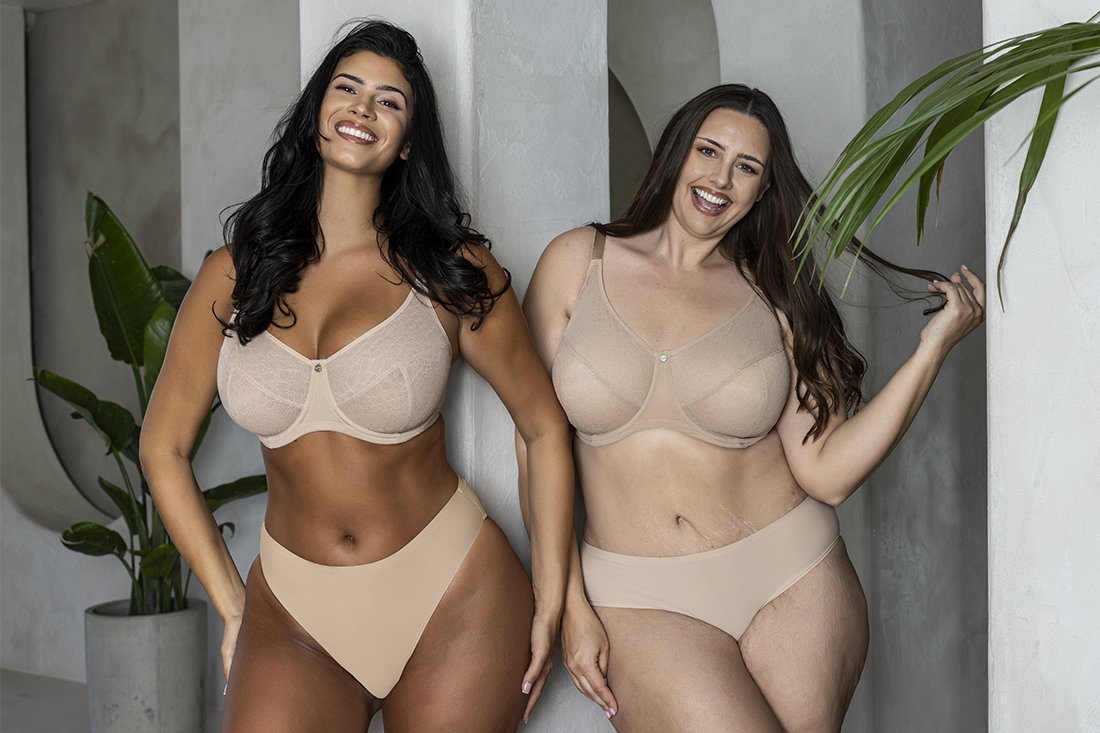
The Luxlacy collection is built around beautiful, delicate lace that reads as indulgent without sacrificing function. The bra styles pair naturally with two strong panty options: the Luxlacy Mesh Hipster (P9005) and the Luxlacy High-Waist Brief (P2005). The high-waist brief in particular is a standout — it offers more coverage through the midsection and creates a longer, smoother line under clothing, all while staying in the same lace family as the bra.

The Shea collection, anchored by the Shea Plunge Bra (P6062) and the Shea T-Shirt Bra (P6061), offers clean, everyday styles that feel cohesive. If you gravitate toward a more minimal, smooth-fabric aesthetic, this collection is a natural foundation for a coordinated drawer.

The Olivia collection, featuring the Olivia Plunge Bra (P4000), pairs elegantly with smooth panty styles in complementary colors. The Pearl collection similarly extends across multiple silhouettes and colorways, giving you flexibility in how you build a coordinated look.

Tips for Mixing and Matching Within a Brand

Even when an exact same-fabric match is not available, you can create a coordinated effect by shopping intentionally within the same brand. A few principles:

Stick to the same color family: a warm nude bra with a warm nude panty reads as a set even if the fabrics differ. Mixing cool and warm tones in the same skin-tone shade family tends to clash.

Match fabric weight and finish: a lace bra pairs best with a lace or mesh panty, while a smooth T-shirt bra looks most cohesive with a smooth or bonded panty. Mixing a very textured bra with a very plain panty can feel mismatched.

Look at the waistband and trim: if both pieces share similar elastic or edge finishing, they will read as coordinated even without being identical.

Consider the silhouette: a high-waist brief creates a different visual effect from a hipster or a French cut. Choose the panty silhouette that makes you feel most confident and works best under the clothes you plan to wear the set with.

Why Investing in a Matching Set Matters for How You Feel

There is something that happens when you put on lingerie that was chosen with intention. It does not matter if no one sees it. You know it is there. A matching set signals to yourself that you are worth the effort — that your comfort and your confidence are both worthy of attention.

For people who have spent years making do with mismatched pieces in sizes that almost fit, a genuine matching set in the right size can be a surprisingly emotional experience. It is not about having something perfect. It is about having something that was made for you.

Confidence is a physical sensation as much as a mental one. When the fabric you are wearing feels cohesive — when the bra and the panty belong together, when the colors complement each other, when everything fits the way it was designed to — there is a different quality to how you carry yourself. That feeling is not frivolous. It is meaningful.

Extended sizes are not an afterthought at Parfait — they are the foundation. The brand was built specifically to serve fuller busts and fuller figures, which means the attention to fit and design that goes into a K cup bra extends to the panties that pair with it. Every piece in the collection is approached with the same level of care, from band construction on the bras to waistband comfort on the underwear.

Find Your Matching Set at Parfait

Browse the full collection at parfaitlingerie.com to find bra and panty pairings across the extended size range. Use the Fit Fix sizing tool to confirm your bra size, then explore the matching panty options in your preferred silhouette. A coordinated set in your size — the one that actually fits — is closer than you might think.

Go Top