
Low-Gore Bras for Close-Set Breasts: Why Gore Height Matters and What to Look For
What Is a Bra Gore and Why Does It Matter?
Most people who wear bras have never thought much about the gore. It’s one of those parts of bra construction that stays invisible until something goes wrong — and then suddenly it’s the only thing you can think about.
The gore is the vertical panel at the center front of a bra that connects the two cups. It sits at the sternum — the breastbone — bridging the gap between your two breasts. Every bra has one, whether it’s a tiny strip of fabric in a plunge style or a wide structured panel in a full-cup bra. And its height (how tall it is, measured from the base of the bra up) has a significant impact on how the bra fits your particular chest anatomy.
A taller gore sits higher on the sternum. This creates more separation between the cup
Parfait Styles With Low Gore and Close-Set Friendly Construction
Parfait’s plunge range is engineered for fuller cup sizes across the entire band range, which means the low-gore construction that works for close-set breasts is paired with the underwire quality and cup depth that actually supports larger sizes.
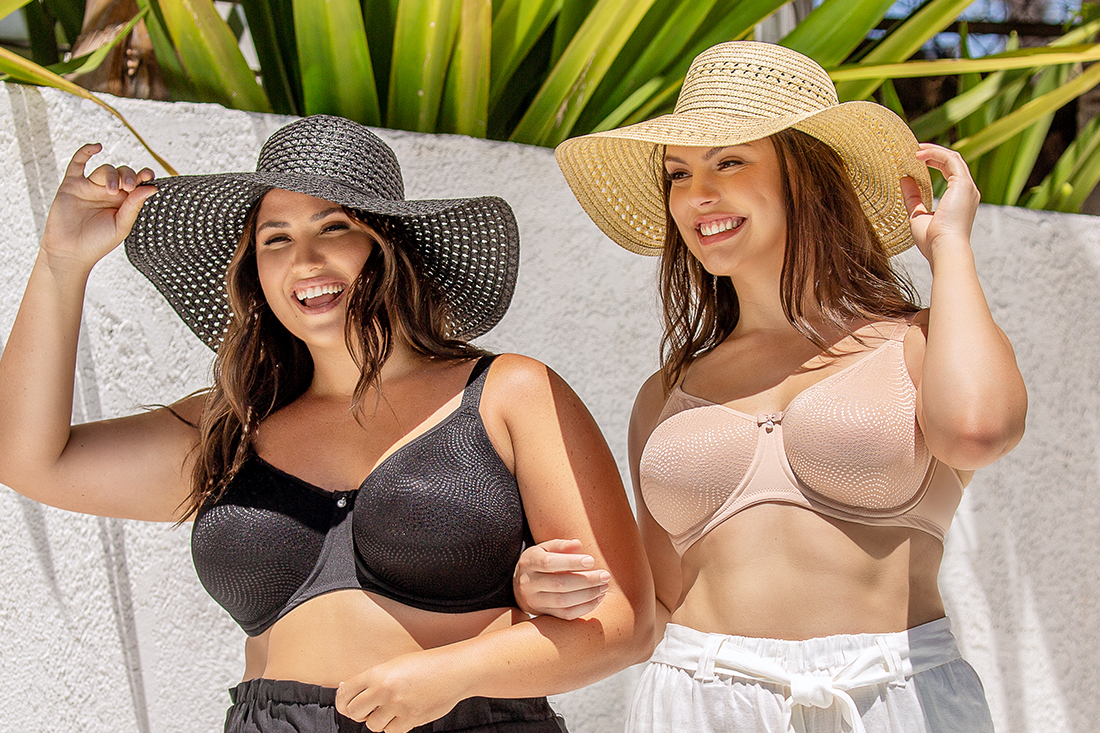
The Shea Plunge Bra (P6062) is an unlined plunge in a lace construction with a genuinely low center front. The V-shaped plunge profile sits at a point where most close-set shapes will find the gore sits comfortably below the space where breast tissue begins, avoiding the pressure and floating problems of taller gores. The unlined construction means there’s no added cup volume to push tissue together — the bra shapes by positioning rather than padding.
The Olivia Plunge Bra (P4000) offers a similar plunge profile in an unlined cup with a different aesthetic — clean and structured rather than lace. The Olivia’s low center front makes it a strong candidate for close-set shapes who find most bras either dig into the sternum or float uncomfortably.
The Casey Plunge T-Shirt Bra (2801) adds molded cup construction for a smooth T-shirt bra profile while maintaining the plunge front. This is particularly useful for close-set shapes who want everyday wear versatility — a smooth, seamless look under fitted clothing — combined with the gore height that suits their anatomy.
For a more structural option with a longer torso line, the Pearl Longline Plunge Bra (P6091) brings the plunge front construction into a longline format. The extended band provides additional support below the cups — useful at larger cup sizes — while the plunge front keeps the gore low for close-set shapes.
How to Measure Gore Height Before You Buy
You can estimate whether a bra’s gore height will work for your chest measurement before buying. The key measurement is the distance from the center of your natural bra line (where the underwire base would sit) up to the point where your breast tissue begins at the inner edge — essentially, how much sternum is available between your breasts.
To measure: wearing a well-fitting bra or immediately after removing one, use a soft tape measure or ruler held vertically at the center of your chest. Measure from the lowest point of where the bra gore sits up to the point where the inner breast tissue starts. A measurement of less than half an inch suggests you need a very low or plunge gore; half an inch to one inch suggests a low gore will work; over an inch gives you more flexibility with gore height.
When reading product descriptions, look for terms like “plunge,” “deep V,” “low center front,” or “low neckline” — these signal a lower gore. Photos taken from the front can also show the gore height: look at how high the center point between the cups extends up the sternum of the model.
If you’re unsure about your measurements, Parfait’s Fit Fix tool at parfaitlingerie.com will help you identify your correct band and cup size, and the customer support team can offer guidance on which styles suit close-set placement. The goal is always a bra that sits flat against your body at the center front — that single fit point has an outsized effect on how everything else works.
What Low-Gore Construction Looks Like
A low-gore bra has a center panel that is cut short — often less than an inch tall — or even a plunge construction where the two cups converge at a very low point with minimal or no traditional gore structure at all. In some plunge styles, the cups meet at a V with only a small piece of hardware or narrow fabric connecting them.
Low-gore construction works for close-set breasts because there’s less material at the center front competing for the limited space between the breasts. The cups can sit properly against the chest wall, the bra can find its natural position, and the center of the bra anchors (or at minimum, doesn’t press into tissue) without creating the poking or floating problems of a tall gore.
What low-gore bras may sacrifice, depending on construction: some degree of separation between the cups (which is fine if you don’t need it, and some close-set women prefer the closer profile anyway), and the centering support that a taller gore provides for some breast shapes. For close-set shapes, these are usually worth trading.
Plunge Bras as the Natural Solution
Plunge bras are the most natural category for close-set breast shapes because their construction philosophy is essentially the opposite of a high-gore bra. A plunge bra is designed to sit low at the center front, with cups angled to allow the breasts to come close together without the center of the bra getting in the way.
The typical plunge construction: cups are angled inward rather than straight across, the gore is minimal (often just a small V at the base), and the cup depth and shape are engineered to provide support from below and the sides rather than from a central anchoring structure. This is why plunge bras work well for low-cut tops — and it’s also why they work structurally for close-set breast placement.
The challenge with plunge bras for larger cup sizes is finding one that combines the low-gore, close-set-friendly construction with the underwire quality, cup structure, and band engineering that larger cups require. A plunge bra that works at a 32C but lacks enough cup structure for a 38G isn’t a real solution for the fuller-bust wearer. This is where fuller-bust specialists like Parfait become specifically relevant.
Understanding Close-Set Breasts
Close-set breasts are those where the two breasts are positioned near or toward the center of the chest, with little or no space between them naturally. Some women with close-set breasts have breasts that nearly touch; others simply have less than an inch of clear sternum between them.
The key characteristic of close-set breasts that matters for bra fit: the space at the center of the chest is minimal. When a bra is designed with a tall gore — expecting a clear inch or more of sternum between the cups — but your breasts sit close together, the gore has nowhere to go. It either pokes into your sternum or, if it can’t sit flat, it floats, leaving a gap at the front of the bra.
Why High-Gore Bras Fail Close-Set Shapes
High-gore bras are designed for women whose breast roots are spaced further apart — where there’s a clear section of sternum between the inner edges of each breast. In that case, a taller gore sits neatly in that space, anchors the bra at the center, and provides excellent structure.
For close-set breasts, a high gore runs into your breast tissue before it reaches your sternum. The fabric panel is physically too long for the available space between your breasts. The result: the gore presses against breast tissue (uncomfortable, sometimes painful) or bends away from your body at an angle (the floating gore effect).
This is why so many bras that look right and even feel okay when you first put them on will start digging in or feel uncomfortable after a few hours. The gore begins pressing against tissue as it warms to body temperature and the material softens slightly. A high gore that starts out merely uncomfortable can become genuinely painful by mid-afternoon.
s and provides more structural anchoring at the center front of the bra. For some breast shapes and positions, this works perfectly — the gore sits flat, anchors the bra, and everything stays in place.
For others, a taller gore is a daily source of misery. If you’ve ever worn a bra where the center panel poked into your sternum or seemed to float away from your chest, creating a visible gap between your skin and the fabric at the front — that’s a gore problem. And it almost always traces back to the relationship between your breast placement and the gore height of the bra you chose.


