
Inclusive Nude Shades in Plus Size Lingerie: Why It Matters and Where to Find Them
The Problem With “Nude”
For most of the twentieth century, lingerie brands used “nude” as a code word for a single shade: a pale peachy-beige that reflected the skin tone of only a narrow portion of the population. If your complexion fell outside that narrow band — whether you’re deep brown, golden tan, warm olive, or anywhere outside the pale-peach range — a nude bra under a white shirt was anything but invisible. It showed up dark, or simply looked like a color rather than a continuation of your skin. The message, often unintentional but no less harmful, was that one skin tone was the default.
The good news is that the conversation around nude in lingerie has shifted significantly over the past decade. Shoppers are demanding a fuller spectrum. Brands are slowly catching up. And the most inclusive lingerie labels are now building their neutral ranges with intention — which means more people can finally get a bra that genuinely disappears under light-colored tops.
Understanding the problem, though, is the first step to solving it. Here’s what “nude” actually needs to mean, and how to find shades that work for you.
What a True Nude Shade Should Do
A true nude is personal, not universal. It’s the shade that most closely matches the skin on your chest and torso — close enough that a bra worn under a thin white or sheer fabric doesn’t create visible contrast. That definition means there is no single nude. There are hundreds of nudes. The “right” nude for you is the one that blends into your specific complexion.
Functionally, a well-matched nude bra serves three purposes. First, it reduces visual contrast under light fabrics, so the bra doesn’t telegraph through sheer blouses or white shirts. Second, it reads as “nothing there” when a top slips slightly or a neckline gapes — which happens to everyone regardless of cup size. Third, it gives you a go-to layer you can stop thinking about, freeing up mental energy for the outfit itself.
If a bra labeled “nude” doesn’t do those three things for your skin tone, it’s not actually nude for you. It’s just a beige bra. The label is the brand’s shorthand, not your experience.
Understanding Your Undertone
Finding your best nude starts with understanding your skin’s undertone, which is different from your surface tone. Surface tone is your overall lightness or darkness — fair, light, medium, tan, deep. Undertone is the subtle warmth or coolness beneath the surface, and it stays relatively consistent even as your surface tone changes with seasons, sun exposure, or age.
There are three broad undertone categories. Warm undertones lean yellow, peachy, or golden — look at the veins on your inner wrist and if they appear greenish, you’re likely warm. Cool undertones have a pink, red, or bluish cast — blue or purple veins suggest cool. Neutral undertones fall somewhere in the middle, often appearing to shift depending on what colors you’re wearing.
For lingerie purposes: if you have warm undertones, you’ll generally find that shades with yellow or golden warmth blend best against your skin. If you have cool undertones, pinkish or rosy neutrals tend to read as “skin” rather than as a distinct color. Neutral undertones have the most flexibility and often work well with a range of shades, though true neutrals without strong warm or cool bias tend to be the most versatile.
Reading Color Names on Lingerie Labels
Once you understand your undertone, you can start reading color names as a first filter. Lingerie brands use different naming conventions, but certain patterns are consistent.
“Warm Sand” and similar earthy descriptors suggest a medium-depth nude with yellow-warm undertones — these tend to work well for medium to deep warm-toned skin. “European Nude” is typically a lighter peachy-beige designed to blend with fair to light cool-to-neutral skin — the “European” shorthand signals a paler, cooler tone. “Bare” is often a very pale, minimally saturated beige with warm undertones, designed for light skin with warmth. “Pearl White” sits at the lightest end of the neutral spectrum — less of a skin-tone match for most people, but functional as an undergarment choice when a true match isn’t available or when layering opacity is the goal.
These names are imperfect guides, and actual product photography doesn’t always represent colors accurately due to lighting and monitor calibration. If you can, seek out review photos from customers with similar skin tones to yours — those real-world photos are far more reliable than campaign imagery.
Parfait’s Neutral and Skin-Tone Colorways
Parfait carries a range of neutral and skin-tone colorways across its bra and underwear lineup, and notably, these neutrals extend across their full size run — not just in standard sizes. That matters because many brands offer inclusive nude shades only in their core size range and revert to a limited palette at the extended ends.
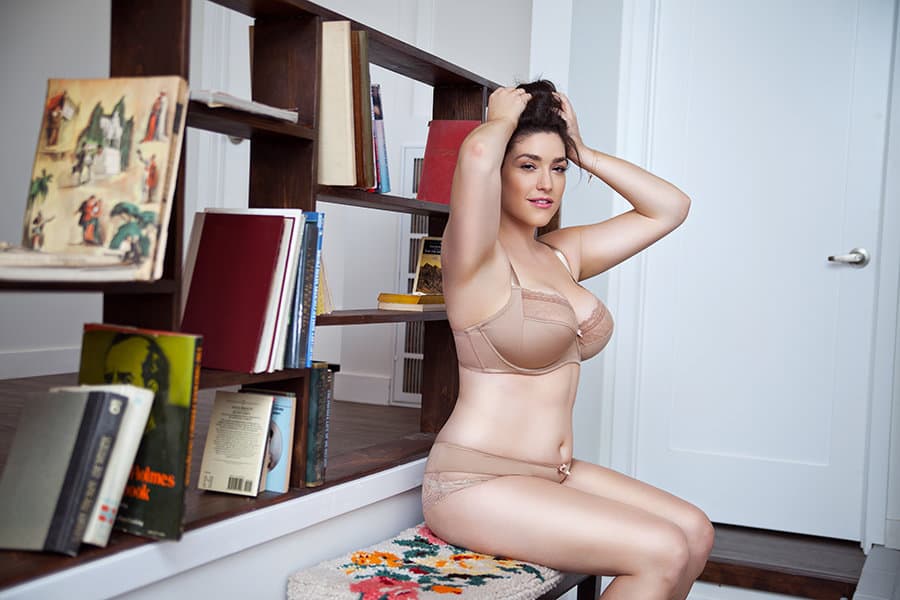
The Emily Unlined T-Shirt Bra (P7800) comes in Warm Sand — a soft, golden-neutral that sits comfortably in the medium-warm range. Because the Emily is unlined with a smooth, seamless cup, it doesn’t add bulk or shadow under light tops, making it a particularly practical choice when you need both a neutral colorway and a low-profile silhouette.
The Casey Plunge T-Shirt Bra (2801) is available in European Nude — a light, peachy-neutral suited to fair to light cool-to-neutral skin tones. It’s a molded plunge style, which means smooth cup construction and a low center front that pairs well with lower-cut tops.
The Shea T-Shirt Bra (P6061) in Bare is a spacer foam construction — a breathable, double-knit structure that has the smooth silhouette of a padded bra without the weight. The Bare colorway is a pale warm-neutral that tends to work well for light skin with warm or neutral undertones.
On the underwear side, the Cozy Brief (PP5032) in Pearl White is a soft, bright neutral — closer to white than a skin tone, but useful for anyone who prefers a light, clean neutral with no color bias. It pairs well under white and pale-colored bottoms.
The Bonded French Cut (PP5031) is worth noting for its bonded seamless construction — even without a neutral colorway, the seamless edges make it a practical choice under form-fitting fabrics. Keep an eye on current colorway offerings for neutral options.
How to Build a Nude Lingerie Wardrobe
If you’re building a neutral lingerie wardrobe from scratch, start with two bras in different shades. One should match or closely approximate your skin tone for warm-colored or sheer tops. A second in a slightly different depth or temperature gives you flexibility for tops that differ in weight or weave.
Don’t limit yourself to one shade. Many people find that they need a lighter neutral for fair areas of their torso and a slightly deeper one for areas with more color — or that the “best” nude for morning light doesn’t match the same way under fluorescent office lighting. Having options removes the frustration of a narrow wardrobe.
For underwear, a mix of skin-tone and neutral options gives you coverage for different clothing situations. Briefs in a shade close to your skin tone are useful under light trousers and fitted skirts. A lighter neutral like Pearl White can work well under fabrics that are light but not sheer.
Use Parfait’s Fit Fix sizing tool at parfaitlingerie.com to confirm your measurements before ordering — having the right size matters as much as the right color. A well-fitted bra in any shade will outperform a poorly fitted one in a theoretically perfect neutral.
Why Representation in Color Design Matters
The push for inclusive nude shades in lingerie isn’t just a cosmetic issue — it has real implications for how women experience shopping and getting dressed. When the only “nude” available doesn’t reflect your skin, the underlying message is that your body isn’t the default, that you’re the exception rather than the rule. That message accumulates.
Parfait was founded in 2010 with a focus on fuller bust and full-figure fit, with bands from 28 to 42 and cups from C to K. The brand has been featured in Forbes, Glamour, Popsugar, Vogue, and the New York Times — in part because it takes seriously the idea that support and fit should be available across a genuine range of bodies, not just a narrow standard. Extending that commitment to color design is a natural continuation of the same principle: every person deserves to find something that fits, and fits in every sense of the word.
Lingerie labels still have a long way to go on true skin-tone inclusivity. But knowing how to navigate what’s available — understanding your undertone, reading color names accurately, using community reviews to ground your decisions — puts you in a much stronger position to find what works. And the more shoppers ask for a fuller spectrum, the faster the industry will move to provide it.


