Shop Now New Bras Undies Lingerie Fit Blog
×

Why 34H Is Actually a Good Size for a Well-Made Bralette

There’s a widespread assumption that the larger the cup size, the more categorically impossible a bralette becomes. The reality is more nuanced than that. Size 34H sits in a sweet spot where a genuinely well-constructed bralette can work — not as a compromise or a wishful-thinking substitute, but as a real option for a meaningful part of your wardrobe.

Here’s why 34H is different from many sizes where bralettes routinely fail. The band measurement of 34 inches provides enough circumference for a firm elastic band to exert useful tension — enough to do actual work — without requiring the kind of structural engineering that very large band sizes demand. The H cup, while significant in volume, is within a range that good bralette construction can address when the garment

How to Style It: Outfits That Let the Bralette Show

The Adriana’s lace construction is designed to be seen. Here are ways to let it work as part of your outfit rather than hiding it:

Under a deep V-neck: If you wear a deep V-neck top or sweater with a neckline that falls to mid-chest, the Adriana’s lace shows at the center — a deliberate layering effect rather than an accident. This works particularly well with sweaters in fall and winter.

As part of a lingerie-as-outerwear look: Paired with a wide-leg trouser and minimal jewelry, a bralette at 34H can carry the visual weight of a top without needing anything else. The key is in the fit — a well-fitting bralette at this size creates a confident, clean silhouette.

Care Tips to Keep It Looking Great

Lace bralettes need more careful handling than everyday bras. The construction that makes the Adriana genuinely supportive also means it’s worth protecting.

Hand wash is best: cool water, gentle lingerie wash, work gently without wringing. If machine washing, use a mesh lingerie bag on the delicate cycle with cold water.

Lay flat or hang to dry. Tumble drying breaks down elastic fibers quickly and distorts the cup shape. Store unfolded when possible — stacking bralettes by folding one cup into the other compresses the structure over time.

A bralette that fits well and is cared for properly will last significantly longer than one that goes through a casual machine wash every week. At 34H, finding a bralette that actually works is worth protecting. Explore the full wire-free range at parfaitlingerie.com, and if you’re unsure about your size, the Fit Fix sizing tool will help you confirm your measurements before you buy.

For days when you need more support than the Adriana provides, the Holly Wire-Free Padded Bra (P8000) offers wire-free support with a more structured cup, and the Charlene Balconette Bra (P5000) brings underwire lift for days when you need full support. Together, these three styles cover the support spectrum from comfortable bralette to wired full-support — giving you real choices at every point in your day.

What “Cute” Looks Like in Extended-Size Bralettes

“Cute” is worth defining here because it’s subjective but not arbitrary. At larger cup sizes, cute in bralette design tends to mean: lace detailing, interesting fabric texture, thoughtful colorways, and silhouettes that reflect current lingerie trends rather than functional-but-boring construction.

Lace is the obvious choice, and for good reason — it photographs beautifully, comes in a huge range of patterns, and provides both visual interest and structural texture that works better for cup support than thin knit. The Adriana’s lace construction is a good example of lace used with intention: it has enough body to serve a structural purpose while looking genuinely pretty.

Silhouette matters in bralettes perhaps more than in wired bras because the bralette is more likely to be intentionally visible. A plunge-style bralette, a longline format, or a scalloped lower edge creates a look that works as outerwear layering or deliberate peek-a-boo styling. At 34H, the silhouette your bust creates in a well-fitting bralette can be genuinely striking — and the right bralette enhances that rather than minimizing it.

Color options also matter. Being offered one nude and one black option is the minimum; if a bralette comes in several colors including something with visual personality, that’s a sign the brand sees this size as a real style choice, not just a necessity.

The Adriana: A Close Look at Why It Works

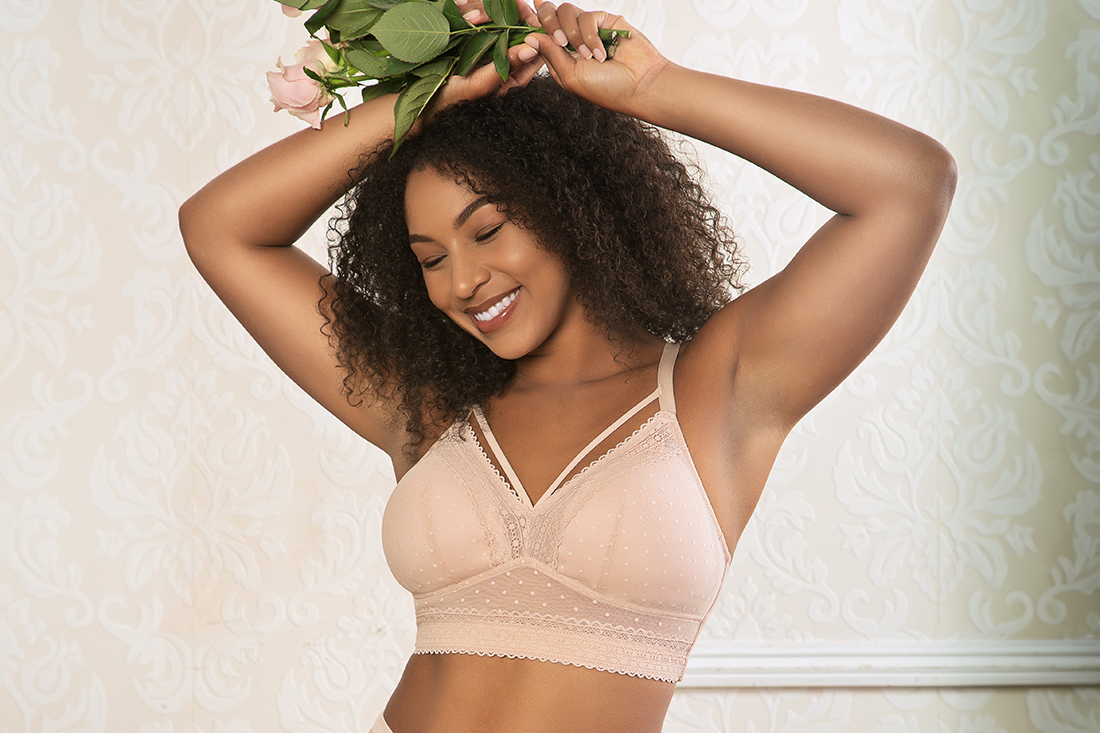
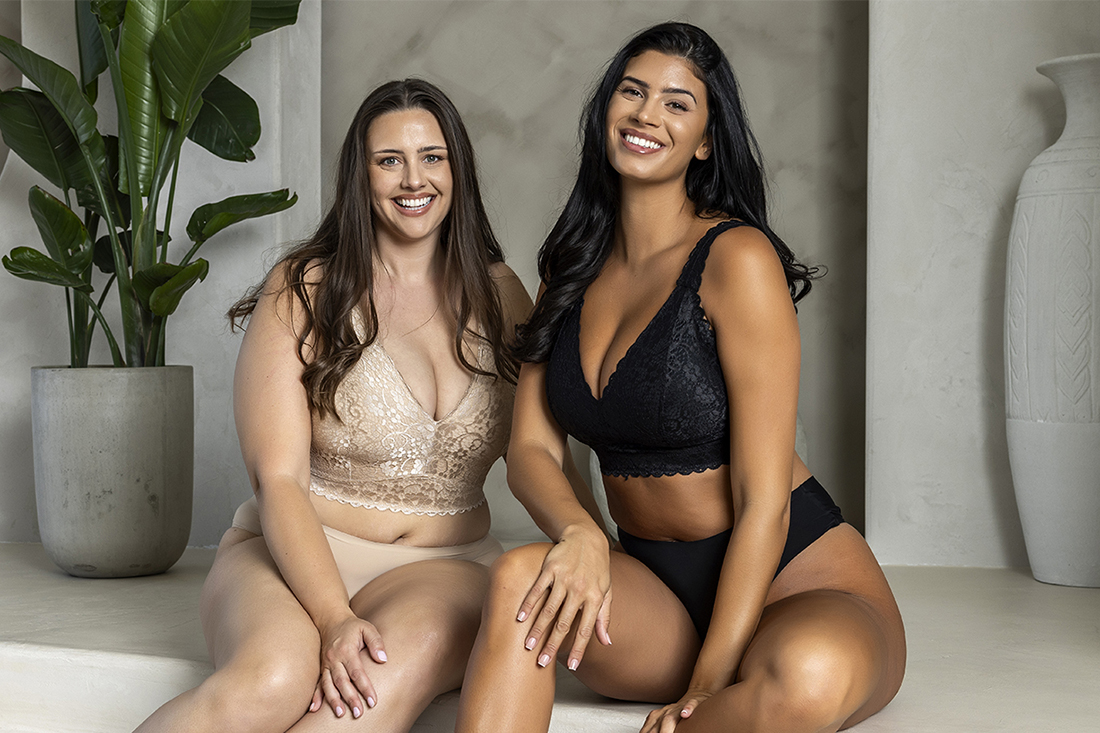
The Adriana Wire-Free Lace Bralette (P5482) is Parfait’s wire-free lace option that brings real support credentials to the bralette category. Several features make it worth the close look.

The lace construction is firm rather than loose — this is structured lace that provides cup definition, not decorative overlay on top of a thin base. This matters enormously at 34H because the fabric is doing actual shaping work. The cups maintain a consistent profile that holds the bust in place rather than simply covering it.

It has a hook-and-eye back closure, which as discussed above makes the fitting process cleaner and the result more reliable. You can set the band exactly where it needs to be and adjust from there.

The straps are positioned and designed for actual support at larger cup sizes, not simply adapted from a small-cup version of the garment. Parfait has been a fuller-bust specialist since 2010, and that expertise shows in the details of how the Adriana is put together. The brand’s range covers bands 28—42 and cups C—K, with the engineering behind that size range taken seriously.

For 34H specifically, the Adriana offers what the size needs: enough cup structure to provide shape and position, a band with real firmness, and attractive construction that doesn’t ask you to sacrifice aesthetics for function.

The Construction Details That Make or Break a 34H Bralette

Start with the band. The underband of a bralette designed for larger cups should be cut from firm elastic — not the loose, stretchy knit you’d find in a fashion bralette sized XS—XL. It should feel snug when you first put it on, and it should stay snug throughout the day. If you can easily slide the band up to your bust, it won’t provide meaningful support. A good test: on the loosest hook (or with a pullover, with the band at your natural bra line), the band should resist stretching by more than an inch or two.

The cup construction matters just as much. Look for cups with some dimensional structure: molded foam, a lined lace cup, or fabric with enough body to hold a shape independently. Thin stretch lace that conforms entirely to the breast does not shape or support — it simply covers. A cup with a seam or a layer of non-stretch lining gives the breast something to rest against rather than simply draping over it.

Look closely at the strap width and placement. Straps for larger cup sizes should be at least an inch wide, ideally more. They should be set to sit slightly wider than the center of the shoulder, avoiding the area where the neck meets the shoulder where a narrow strap causes the most pain. Adjustable straps are strongly preferred — different torso heights and shoulder widths mean that the adjustment range matters for actually getting the right length.

A back closure is important for 34H specifically. Pulling a bralette over your head and trying to position the cups correctly while struggling against a resistant band is harder than it sounds at this cup size. A hook-and-eye closure lets you fasten the band first, set it correctly, and then position the cups — the same way a wired bra fits. That difference in how you put it on translates to a better fit throughout the day.

What “Supportive” Has to Mean at 34H

At 34H, supportive cannot mean “holds things approximately in place for light movement.” It needs to mean: band stays firmly positioned at the ribcage throughout the day, cups maintain consistent breast position without migration, straps don’t cut into shoulders, and you finish a normal day without neck or back discomfort you didn’t have before putting it on.

Those are honest benchmarks. If a bralette fails any of them for you by mid-afternoon, it isn’t supportive enough for your needs at this size. There’s no shame in that — it’s simply information about what your body requires.

Genuine support at 34H requires specific construction: a firm, relatively wide band with minimal stretch, cups with enough shaping to prevent the fabric from simply moving with the breast rather than holding it, some form of structural element at the lower cup (whether boned, channeled, or heavily banded), and straps wide and positioned correctly enough to share the load without digging in.

is actually designed for it.

Compare this to a 44H or 38K, where the engineering demands become much harder to meet without wires, or a 28K, where the band is so short that elastic tension alone can struggle to provide enough anchoring. At 34H, the geometry cooperates. The key word, though, is “well-made.” Not every bralette claiming extended-cup support will deliver. The difference between one that works and one that doesn’t comes down to construction specifics, not marketing language.

Center Lift vs. Lateral Push: Understanding the Difference

Not all lift is the same. When most people talk about a bra that lifts, they mean upward elevation — the general impression of a higher, more defined bust. But the direction of that lift matters enormously for how the bust looks and feels, and different bra constructions produce lift in different directions.

Center lift moves breast tissue upward and inward — toward the midline of the body — creating a profile that is elevated and centered without projecting outward from the chest wall or spreading toward the sides. Lateral push, by contrast, moves tissue outward and to the sides, sometimes creating a wider, lower silhouette despite technically lifting the bust off the chest.

Many women specifically want center lift without outward projection. Push-up bras are

Parfait Styles That Lift and Center

Parfait’s minimizer styles are engineered with redistribution in mind rather than simply compression, and they represent a strong option for women who want center lift without outward spread.

The Pearl Minimizer Bra (P60921) uses a seamless cup construction that provides smooth, even coverage while the cup shape directs projection forward and centrally rather than laterally. Its side panel tension keeps tissue contained without compressing it against itself.

The Enora Minimizer Bra (P5272) offers structured cup seaming that contributes to upward lift, with a gore that sits at a height that provides sternum support without digging in. The Enora’s construction is designed specifically for fuller cup sizes where controlling both projection and lateral spread matters most.

For those who don’t need minimizer-level projection control but still want center lift from a well-constructed underwire bra, the Charlene Balconette Bra (P5000) creates strong upward lift from its balconette cup shape and defined gore. The balconette profile — wide, horizontal cup opening, high side and center coverage — is naturally suited to centered lift rather than outward projection.

The Emily Unlined T-Shirt Bra (P7800) and Bliss Padded T-Shirt Bra (P7000) offer clean, smooth cup profiles for everyday wear, with the underwire placement and cup construction Parfait uses in its fuller-bust range to provide genuine lift rather than simply coverage.

Fit Tips for Achieving the Shape You Want

Even the best-engineered bra won’t create center lift if the fit is off. Here are the key fit points that determine whether center lift happens:

The band must be firm. If the band rides up at the back, the front of the bra will drag down, pulling the cups and the tissue in them downward and outward rather than upward. A band that fits means it stays parallel to the floor all the way around.

The gore must sit flat on the sternum. Press the gore gently against your sternum — it should make contact along its entire length. If it floats, either the cups are too small, the cup shape doesn’t suit your breast root width, or both. A floating gore means the cups are pulling away from center, which defeats center lift entirely.

The cups must be filled without overflow. If tissue is escaping over the top or sides of the cup, the cup is too small. An overfull cup creates the pushed-outward shape that center lift is meant to avoid.

Use Parfait’s Fit Fix tool at parfaitlingerie.com to check your measurements before choosing. The fuller-bust range — bands 28—42, cups C—K — means there are genuine options at every size, and getting the right measurement is the first step toward getting the right shape.

What Construction Creates Lift Without Outward Projection

Several construction features work together to create center lift without lateral push or excessive forward projection:

A full cup or balconette shape with structured cup seaming creates a projection profile that is more forward-and-upward than outward. The cups cradle the breast from below and the sides and lift it, rather than pushing from underneath.

Side panels with strong tension hold tissue in from the sides. A well-fitted bra with firm side panels prevents lateral migration regardless of how the cups are shaped — tissue stays in the cup rather than spreading toward the arms.

A center gore that sits flat against the sternum keeps both cups from migrating outward. When the gore floats away from the sternum, the cups have drifted, and the bust is being pushed laterally rather than lifted centrally.

Moderate cup projection (rather than deep or padded cup projection) results in a shape that doesn’t push the bust dramatically away from the chest. A contour cup with moderate projection creates lift and shape without adding the appearance of significantly more volume or forward extension.

Gore Height and Its Role in Centering the Bust

The gore is the vertical strip of fabric between the two cups at the center front of the bra. Its height — how far it extends up the sternum — has a direct relationship to how centered and lifted the resulting bust shape is.

A taller gore sits higher on the sternum, separating the cups and providing a clear center channel. This creates definition between the breasts and encourages each cup to project independently and upward rather than together. Balconette and full-cup styles often have moderate to tall gores that serve this purpose well.

A lower or plunge gore (short and cut low at the center front) brings the cups closer together, reducing the separation between breasts. This can look different depending on breast shape — for some women it creates cleavage and center lift; for others it allows tissue to push inward without adequate separation, creating compression rather than lift.

For center lift specifically, a moderate gore height tends to work best: tall enough to provide structural separation and anchoring, but not so tall that it digs into the sternum or pulls the cups apart uncomfortably.

The Mechanics of Underwire Angle and Cup Shape

The underwire is the primary architectural element that determines where breast tissue goes. The wire sits at the base and sides of the breast, and its angle, curvature, and width define the shape that the cup creates.

A wire with a deep curve and relatively narrow width (a narrow wire profile) runs more closely along the natural breast root — the area where the breast attaches to the chest wall. This type of wire encourages tissue to move upward and inward. When the wire sits snugly against the breast root at the sides and base, it doesn’t allow tissue to migrate toward the armpits, and the cup shape directs projection forward and slightly upward.

A wide wire with a shallower curve sits further from the breast root. It creates more surface coverage but allows more lateral migration — breast tissue can spread toward the arms more easily because the wire doesn’t contain it. Some women need wider wires for comfort (if their breast root is naturally wide), but for women whose breasts project forward and who want center lift, a wide wire often works against them.

Cup seam placement and cup height also contribute. A cup with a vertical seam running up the center of the cup creates a point of projection forward and upward. A cup with a horizontal seam that divides the cup into upper and lower sections tends to create a rounder, more lifted shape. Both can create center lift, but they do it differently, and one may work better for a given breast shape than the other.

Why Push-Up Bras Often Fail This Goal

Push-up bras are explicitly engineered to push breast tissue upward and inward from the bottom and sides of the cup — which sounds like center lift, but in practice often produces lateral projection and cleavage by pushing tissue against the sternum and upward out of the cup rather than toward the sternum and gently upward in a supported way.

The angled pads in a push-up bra sit at the outer and lower edges of the cups. They push tissue diagonally toward the center and up, which can create a pushed-together look — but that push often results in breast tissue spilling over the top of the cup rather than being cleanly lifted. For larger cup sizes, this effect is amplified: more tissue to push, more likely it will overflow.

Push-up construction is also specifically designed to increase outward projection — the padded base moves the bust further from the chest wall. This is the opposite of what many women want when they ask for center lift. They want the bust to feel elevated and contained, not pushed further forward.

The better alternative is a bra where the cup itself creates the lift through its shape, seaming, and underwire placement, rather than relying on padding to mechanically force tissue in a direction.

engineered to increase projection — not to center or lift — and for women who want lift without outward push, they often produce exactly the wrong result. Understanding which construction features create which type of lift lets you shop intentionally.

What Is a Bra Gore and Why Does It Matter?

Most people who wear bras have never thought much about the gore. It’s one of those parts of bra construction that stays invisible until something goes wrong — and then suddenly it’s the only thing you can think about.

The gore is the vertical panel at the center front of a bra that connects the two cups. It sits at the sternum — the breastbone — bridging the gap between your two breasts. Every bra has one, whether it’s a tiny strip of fabric in a plunge style or a wide structured panel in a full-cup bra. And its height (how tall it is, measured from the base of the bra up) has a significant impact on how the bra fits your particular chest anatomy.

A taller gore sits higher on the sternum. This creates more separation between the cup

Parfait Styles With Low Gore and Close-Set Friendly Construction

Parfait’s plunge range is engineered for fuller cup sizes across the entire band range, which means the low-gore construction that works for close-set breasts is paired with the underwire quality and cup depth that actually supports larger sizes.

The Shea Plunge Bra (P6062) is an unlined plunge in a lace construction with a genuinely low center front. The V-shaped plunge profile sits at a point where most close-set shapes will find the gore sits comfortably below the space where breast tissue begins, avoiding the pressure and floating problems of taller gores. The unlined construction means there’s no added cup volume to push tissue together — the bra shapes by positioning rather than padding.

The Olivia Plunge Bra (P4000) offers a similar plunge profile in an unlined cup with a different aesthetic — clean and structured rather than lace. The Olivia’s low center front makes it a strong candidate for close-set shapes who find most bras either dig into the sternum or float uncomfortably.

The Casey Plunge T-Shirt Bra (2801) adds molded cup construction for a smooth T-shirt bra profile while maintaining the plunge front. This is particularly useful for close-set shapes who want everyday wear versatility — a smooth, seamless look under fitted clothing — combined with the gore height that suits their anatomy.

For a more structural option with a longer torso line, the Pearl Longline Plunge Bra (P6091) brings the plunge front construction into a longline format. The extended band provides additional support below the cups — useful at larger cup sizes — while the plunge front keeps the gore low for close-set shapes.

How to Measure Gore Height Before You Buy

You can estimate whether a bra’s gore height will work for your chest measurement before buying. The key measurement is the distance from the center of your natural bra line (where the underwire base would sit) up to the point where your breast tissue begins at the inner edge — essentially, how much sternum is available between your breasts.

To measure: wearing a well-fitting bra or immediately after removing one, use a soft tape measure or ruler held vertically at the center of your chest. Measure from the lowest point of where the bra gore sits up to the point where the inner breast tissue starts. A measurement of less than half an inch suggests you need a very low or plunge gore; half an inch to one inch suggests a low gore will work; over an inch gives you more flexibility with gore height.

When reading product descriptions, look for terms like “plunge,” “deep V,” “low center front,” or “low neckline” — these signal a lower gore. Photos taken from the front can also show the gore height: look at how high the center point between the cups extends up the sternum of the model.

If you’re unsure about your measurements, Parfait’s Fit Fix tool at parfaitlingerie.com will help you identify your correct band and cup size, and the customer support team can offer guidance on which styles suit close-set placement. The goal is always a bra that sits flat against your body at the center front — that single fit point has an outsized effect on how everything else works.

What Low-Gore Construction Looks Like

A low-gore bra has a center panel that is cut short — often less than an inch tall — or even a plunge construction where the two cups converge at a very low point with minimal or no traditional gore structure at all. In some plunge styles, the cups meet at a V with only a small piece of hardware or narrow fabric connecting them.

Low-gore construction works for close-set breasts because there’s less material at the center front competing for the limited space between the breasts. The cups can sit properly against the chest wall, the bra can find its natural position, and the center of the bra anchors (or at minimum, doesn’t press into tissue) without creating the poking or floating problems of a tall gore.

What low-gore bras may sacrifice, depending on construction: some degree of separation between the cups (which is fine if you don’t need it, and some close-set women prefer the closer profile anyway), and the centering support that a taller gore provides for some breast shapes. For close-set shapes, these are usually worth trading.

Plunge Bras as the Natural Solution

Plunge bras are the most natural category for close-set breast shapes because their construction philosophy is essentially the opposite of a high-gore bra. A plunge bra is designed to sit low at the center front, with cups angled to allow the breasts to come close together without the center of the bra getting in the way.

The typical plunge construction: cups are angled inward rather than straight across, the gore is minimal (often just a small V at the base), and the cup depth and shape are engineered to provide support from below and the sides rather than from a central anchoring structure. This is why plunge bras work well for low-cut tops — and it’s also why they work structurally for close-set breast placement.

The challenge with plunge bras for larger cup sizes is finding one that combines the low-gore, close-set-friendly construction with the underwire quality, cup structure, and band engineering that larger cups require. A plunge bra that works at a 32C but lacks enough cup structure for a 38G isn’t a real solution for the fuller-bust wearer. This is where fuller-bust specialists like Parfait become specifically relevant.

Understanding Close-Set Breasts

Close-set breasts are those where the two breasts are positioned near or toward the center of the chest, with little or no space between them naturally. Some women with close-set breasts have breasts that nearly touch; others simply have less than an inch of clear sternum between them.

The key characteristic of close-set breasts that matters for bra fit: the space at the center of the chest is minimal. When a bra is designed with a tall gore — expecting a clear inch or more of sternum between the cups — but your breasts sit close together, the gore has nowhere to go. It either pokes into your sternum or, if it can’t sit flat, it floats, leaving a gap at the front of the bra.

Why High-Gore Bras Fail Close-Set Shapes

High-gore bras are designed for women whose breast roots are spaced further apart — where there’s a clear section of sternum between the inner edges of each breast. In that case, a taller gore sits neatly in that space, anchors the bra at the center, and provides excellent structure.

For close-set breasts, a high gore runs into your breast tissue before it reaches your sternum. The fabric panel is physically too long for the available space between your breasts. The result: the gore presses against breast tissue (uncomfortable, sometimes painful) or bends away from your body at an angle (the floating gore effect).

This is why so many bras that look right and even feel okay when you first put them on will start digging in or feel uncomfortable after a few hours. The gore begins pressing against tissue as it warms to body temperature and the material softens slightly. A high gore that starts out merely uncomfortable can become genuinely painful by mid-afternoon.

s and provides more structural anchoring at the center front of the bra. For some breast shapes and positions, this works perfectly — the gore sits flat, anchors the bra, and everything stays in place.

For others, a taller gore is a daily source of misery. If you’ve ever worn a bra where the center panel poked into your sternum or seemed to float away from your chest, creating a visible gap between your skin and the fabric at the front — that’s a gore problem. And it almost always traces back to the relationship between your breast placement and the gore height of the bra you chose.

What “Center-Full” Means and Why It Matters for Fit

One of the most common shape variations that creates consistent bra fit problems is center-fullness. A center-full breast has more volume concentrated at the inner part of the cup — the side closest to the sternum — and projects forward rather than spreading to the sides. Women with center-full breasts often have breasts that are close-set, that sit fairly high on the chest, and that project somewhat from the chest wall rather than spreading wide.

The combination of these characteristics — inner volume, close setting, forward projection — creates specific challenges with most standard bra construction, and particularly with underwire placement. If you’ve ever worn a bra that seemed like it should fit from a size perspective but had the inner wire constantly digging into the breast rather than sitting flat against the chest wall, center-fullness is likely the explanation.

Understanding your breast shape allows you to shop with intention rather than trial and error. For center-full shapes, wire width and cup style are the most important variables to control.

The Underwire Width Problem for This Shape

Underwires are sized — they come in different widths for different purposes. A wide wire covers more lateral territory; its inner end sits closer to the sternum and its outer end extends further toward the armpit. A narrow wire covers less territory; it sits closer to the breast root along both edges.

For center-full breast shapes, a wide wire is a persistent source of discomfort. The inner end of a wide wire extends past the point where the breast root ends and presses into breast tissue — or worse, into the sternum itself. This is the wire-digging-in problem that many women attribute to “wrong size” when the size is actually correct but the wire width is wrong for their anatomy.

The inner end of the underwire is specifically the problem point for center-full shapes. Because center-full breasts have more tissue on the inner side of the cup, the wire needs to sit exactly at the edge of the breast root — not beyond it. A wire that extends even a small amount past that edge will press into tissue with every movement, and that pressure accumulates over a day into significant discomfort.

Narrow underwires sit snugly within the breast root, following the natural boundary of where the breast attaches to the chest wall. For center-full shapes, this is what allows the wire to do its job — providing lift and shape from below — without the inner end becoming a pressure point.

How to Identify Wire Width Before Buying

Wire width isn’t usually listed as a specification in product descriptions, which makes identifying it before buying somewhat indirect. The best approach is to use cup style as a proxy, because different cup styles are consistently constructed with different wire widths.

Photographs from the front can give you a rough sense of wire width. Look at how far the wire ends extend: does the inner end of the wire appear to sit right at the sternum edge, or does it seem to extend significantly toward center? On a model wearing the bra, you can sometimes see the wire outline through thin fabric, or infer it from where the cup fabric ends at the inner edge.

Brand fitting expertise also matters. A brand specifically designed for fuller-bust sizes will have considered wire dimensions as part of cup engineering across its size range, rather than simply scaling up wires that were designed for smaller sizes. Parfait, as a fuller-bust specialist with a range extending to K cup, approaches this engineering with that expertise built in.

The Relationship Between Cup Style and Wire Placement

Cup style is the most accessible proxy for wire width, because it’s described explicitly in product listings.

Plunge cups are consistently narrower-wired than other styles. A plunge cup is designed to allow the breasts to sit close together at the center, with a low gore and inward-angled cups. The wire in a plunge bra runs close to the natural breast root, stopping near the inner edge of each breast rather than extending toward the sternum. For center-full shapes, this is the most reliably comfortable wire placement.

Balconette cups have wider cups that open more horizontally. The wire in a balconette runs further laterally, covering more of the side of the breast. The inner wire end is typically narrower than a full cup, but wider than a plunge. Some center-full shapes find balconette wires work; others find the inner wire end still sits past the comfortable zone.

Full-cup bras have the widest wires of any style. They’re designed to encircle and support a larger proportion of the breast from below, which means the inner wire end extends further inward. For center-full, close-set shapes, full-cup underwires are typically the most problematic. A full-cup may seem like the most supportive option — and in terms of coverage it is — but the wire width often makes it uncomfortable for this shape.

Plunge Construction and Its Advantage for Center-Full Shapes

Plunge bras were originally designed to work under low-cut clothing, but their structural characteristics make them well-suited to center-full breast shapes for reasons beyond neckline compatibility.

The plunge cup shape creates projection by pointing the cup slightly inward and forward — which is exactly what a center-full, forward-projecting breast needs. The cup doesn’t try to contain the breast in a wide, lateral shape; instead it provides support and structure in a direction aligned with how the breast naturally projects.

The low gore of a plunge bra works with close-set placement (a common characteristic of center-full shapes) as discussed in depth in conversations about gore height. But the wire geometry is equally important: narrower wires that sit within the breast root rather than extending past it are the key structural advantage for this shape.

Parfait Styles to Try for Center-Full Breasts

Parfait’s plunge range is a natural starting point for center-full shapes because the wire geometry aligns with what this breast shape needs.

The Shea Plunge Bra (P6062) is an unlined plunge in lace with the narrow wire geometry that characterizes plunge construction. Unlined means no added inner-cup volume, and the plunge shape provides support aligned with center-full projection. For women who find most bras dig into the inner breast, the Shea is worth trying as a first step in the Parfait range.

The Casey Plunge T-Shirt Bra (2801) brings a molded T-shirt bra surface to plunge construction. This works well for center-full shapes who want a smooth, seamless look under fitted clothing — the molded cup provides the clean outer profile of a T-shirt bra without the wider wire that most full-cup T-shirt bras have.

The Olivia Plunge Bra (P4000) offers a clean unlined plunge profile with a structure suited to fuller cups. Its construction follows the same plunge logic: narrow wire placement, inward cup angle, low gore — the three features that consistently work for center-full shapes.

For a more structured profile with longer torso coverage, the Pearl Longline Plunge Bra (P6091) extends the band below the cups for additional support while maintaining the plunge wire geometry. The longline format can be useful for center-full shapes at larger cup sizes where the extended band provides additional anchoring.

Fit Troubleshooting for This Shape

A few specific fit symptoms and what they mean for center-full shapes:

Inner wire digs into breast or sternum: The wire is too wide for your breast root. Try a plunge style or move to a narrower cup shape. This is not a size issue — going up or down a cup size will not fix a wire width problem.

Gore floats away from sternum: The gore is too tall for your breast placement, or the cup shape isn’t matching your breast’s projection direction. Try a plunge bra with a lower gore.

Cups gap at the top edge: The cup is either too large in volume or the cup shape doesn’t match your projection profile. Center-full breasts fill the inner cup more than the outer; a cup that fits wide-set or side-full shapes may gap at the top for center-full shapes. A plunge or balconette shape often fits better than a full cup for this reason.

Wire sits in breast tissue at the outer edge: The wire is too wide at the outer edge too, not just the inner. This suggests you may need a narrower cup style overall, and may also benefit from a smaller back size with a larger cup (sister sizing) to get a wire that sits further inward overall.

Use the Fit Fix tool at parfaitlingerie.com to establish your size baseline before troubleshooting shape fit. Getting the band and cup size correct is the prerequisite for all other fit decisions. Parfait’s size range — bands 28—42, cups C—K — means there are genuine options at your size, and the plunge styles in the range are engineered for the fuller bust rather than adapted from smaller sizes.

The Padding Myth: Not All Padding Adds Size

There’s a persistent conflation in the way lingerie is talked about: padding equals added cup size. It’s an understandable assumption — push-up bras are padded, and they exist specifically to make the bust appear larger. But padding is a construction technique that serves several distinct purposes, and adding volume is only one of them.

Padding can also be used to create smooth surfaces, to provide structure to a cup that would otherwise be floppy, to eliminate nipple show-through, to give the cup a defined shape so it doesn’t collapse against itself in a drawer, and to provide light projection control. In most of these uses, padding has nothing to do with making the bust look bigger — it’s doing a structural or functional job that would otherwise require a different construction approach.

Once you understand this distinction, shopping for padded bras becomes a much more precise exercise. The question isn’t “does this bra have padding?” but rather “what is the padding doing, and will it add apparent volume or shape without size?”

How Padding Is Used for Shape vs. Volume

Volume-adding padding is thick, foam-filled, and often angled or contoured to push breast tissue upward and outward from the bottom of the cup. This is the padding in a push-up bra. It sits at the base and inner edge of the cup and physically moves tissue in a direction — creating the appearance of more projection and more cup size than the natural breast provides. The foam is usually firm, thick (sometimes an inch or more at the thickest point), and wedge-shaped.

Shape-creating padding is thin, even, and consistent across the cup surface. Its purpose is to give the cup a defined profile — a smooth, round outer surface — without pushing the breast in any direction. The cup holds its shape on a hanger the same way it does on the body, but it’s doing that through structure, not through moving tissue. This kind of padding adds perhaps a few millimeters of cup profile, not a full cup size of volume.

Between these two poles, there’s a range. Lightly padded cups — sometimes described as “light padding,” “soft padding,” or a very thin foam layer — add minimal volume and are primarily concerned with smooth surface texture and nipple coverage. Spacer fabric cups use a construction that creates a defined cup shape without traditional foam padding at all (more on this below). And unlined cups with structured underwiring use the wire and seaming to create shape without any padding.

The key question to ask of any padded bra: is the padding adding projection, or is it adding surface quality and cup definition? The former adds apparent size; the latter adds wearability without changing how much space the bust takes up.

What the Label Terms Actually Mean

Product descriptions use several terms in this space that can be confusing without context.

“Lightly padded” or “softly padded”: A thin layer of foam or fiberfill that smooths the cup surface and adds slight warmth and nipple coverage. Adds minimal visible volume. Typically one step up from fully unlined in terms of cup definition, without the thickness or angling of a push-up pad.

“Contour cup” or “molded cup”: A cup pre-formed to a breast shape by heat-molding foam. Holds its shape independently of the breast inside it. This adds defined shape (the cup looks the same empty as full) but the thickness is usually even and moderate — adding structure and smooth surface without dramatic volume increase.

“Push-up” or “plunge push-up”: Specifically indicates volume-adding padding with angled inserts designed to push tissue together and upward. This does add apparent cup size.

“Unlined” or “non-padded”: No foam layer at all. The cup is fabric only — lace, mesh, microfiber, or other textiles directly against the skin. These bras shape through seaming, underwire placement, and cup construction, not padding.

“Spacer” or “spacer foam”: A specific 3D fabric construction (not traditional foam) that creates a structured cup surface. Worth a separate explanation below.

“Minimizer”: Designed to redistribute breast tissue to reduce forward projection and apparent cup size. Despite sometimes using padding, the goal is reduction of apparent volume, not increase.

The Spacer Fabric Difference

Spacer fabric deserves its own discussion because it’s one of the best examples of padding technology that creates shape without adding volume.

Spacer fabric is a technical textile with a three-dimensional structure: two outer fabric layers connected by a thin mesh core that holds them apart. This creates a lightweight, breathable, structured material that maintains a cup shape without using traditional dense foam. The “spacing” between the layers is usually just a few millimeters — enough to give the cup a defined, smooth surface but not enough to add visible cup volume to the wearer.

The benefits for shape-without-volume dressing are significant. Spacer cups are highly breathable (the mesh core allows air circulation between the layers, making them cooler to wear than foam-lined cups). They hold their shape well over time and after washing. They provide a clean, smooth surface under clothing — the primary goal of a T-shirt bra — without adding projection.

Spacer cups feel lighter than foam cups because they are literally lighter — less material, more air. For women who find foam cups hot or heavy, this is a meaningful quality difference. And for women who want the smooth, structured look of a T-shirt bra without the added-size effect of a foam cup, spacer construction is the specific answer to that specific need.

Parfait Styles That Shape Without Adding Volume

Parfait’s range includes specific examples of each padding approach — from spacer construction to lightly contoured cups — and understanding which does what helps you choose intentionally.

The Bliss Padded T-Shirt Bra (P7000) uses spacer construction — the breathable, three-dimensional fabric technology described above. The spacer cup gives the bra a smooth, defined profile without the weight or additional projection of foam padding. For everyday T-shirt bra wear where you want a clean look without added volume, this is the construction to reach for.

The Shea T-Shirt Bra (P6061) also uses spacer fabric, bringing the same breathable, shape-without-volume construction to a different silhouette. The Shea is specifically built for the T-shirt bra use case — invisible under clothing, comfortable all day, structured enough to eliminate nipple show-through — without adding cup projection. For women in fuller cup sizes who want the practical performance of a T-shirt bra without the pushed-forward effect of foam, both the Bliss and the Shea are designed around this exact requirement.

The Casey Plunge T-Shirt Bra (2801) uses a molded cup construction. Molded cups create a defined shape through the cup’s pre-formed structure, and the Parfait version is designed to provide that smooth T-shirt bra surface without excessive padding depth. The plunge construction also means a lower center front — useful if you want to wear it under V-neck or open-neckline tops.

The Emily Unlined T-Shirt Bra (P7800) takes the concept to its logical conclusion: a T-shirt bra with no lining, creating shape entirely through seaming and underwire without any padding at all. For women who find that any foam or lining adds more cup presence than they want, an unlined T-shirt bra — when the seaming and wire placement are right — provides a natural shape that follows the breast without amplifying it.

For women specifically seeking to reduce the appearance of cup volume, the Pearl Minimizer Bra (P60921) uses seamless construction to redistribute and contain tissue with a smooth outer profile. Minimizer construction is the most active form of shape-without-volume engineering: it uses the cup structure to create a profile that appears smaller than the natural bust while still providing full support and coverage.

How to Try a Padded Bra Without Getting the Wrong Effect

When trying a new padded or lightly padded bra, the key test is not whether the cups look great on the hanger but whether the shape it creates on your body matches your intention.

Building a Wardrobe Around Shape-Not-Volume Bras

Once you’ve identified what type of padding works for your goals, building a small collection around that understanding makes getting dressed simpler.

A spacer T-shirt bra (like the Bliss or Shea) is the workhorse for everyday wear under fitted tops. Its breathability makes it comfortable through long days; its smooth surface makes it genuinely invisible under most fabrics.

A plunge-molded option (like the Casey) for specific necklines and occasions where you need a clean front without padding adding projection.

These four styles cover the full range from natural-shape to controlled-shape, all without volume addition. The result is a bra wardrobe that lets you dress intentionally every day, with undergarments that work with your clothing rather than changing the silhouette you’re trying to create.

All of these styles are available in Parfait’s fuller-bust range — bands 28—42, cups C—K — at parfaitlingerie.com. Use the Fit Fix sizing tool to confirm your measurements and find the right starting point for each style.

Why Real Customer Photos Change the Purchase Decision

When you’re shopping for lingerie in an extended size — and especially in a fuller-bust size that most brands don’t stock in stores — you’re often making a significant decision based on limited information. A product page might show one or two campaign photos, professionally lit, on a model whose size may or may not match yours, in an image that’s been styled and retouched until the bra looks its very best. That photograph tells you what the bra looks like in ideal conditions. It doesn’t tell you how it fits.

Real customer photos change this equation. A photo uploaded by someone who wears a 38GG, or a 32H, or a 40F — taken in normal lighting, in a bathroom mirror, with all the imperfections of a real body in a real bra — tells you things a campaign photo cannot. Does the band ride up? Does the cup gap at the top? Does the underwire sit flat against the chest wall, or does it dig in at the sides? Does the bra look like the product page, or does it look completely different in practice?

For shoppers in sizes that are hard to try on in person — because stores don’t carry them — this kind of evidence is the closest thing to trying the bra on yourself. It reduces uncertainty, increases purchase confidence, and significantly lowers the chance of a disappointing return.

What Professional Campaign Photos Can’t Tell You

Professional lingerie photography is designed to sell a feeling, not document a fit. Styling teams use clips, tape, and pins to make bras sit perfectly for a photograph. Models are chosen because they present the product at its most flattering. Lighting is calibrated to minimize shadows that might reveal where a cup is gaping or where the band is pulling. Post-processing smooths anything that remains.

None of this is inherently deceptive — it’s industry-standard product photography, and consumers generally understand that marketing images are idealized. But it does mean that campaign photos have genuine blind spots. They rarely show the back band clearly enough to assess how it sits. They rarely photograph the underbust, where band fit is easiest to assess. They often show bras only in one or two sizes, leaving anyone outside those sizes guessing about how the proportions scale.

Extended-size shoppers are particularly disadvantaged by this because the fit challenges specific to larger cup sizes — underwire that sits on breast tissue instead of chest wall, cups that gape at the top, straps that dig in at small bands — are exactly the kinds of fit details that campaign photography systematically conceals.

How to Extract Fit Intelligence From Customer Reviews

Not all customer reviews are equally useful. A review that says “love this bra, so comfortable!” is positive reinforcement for the brand but doesn’t help you make a fit decision. Learning to extract genuine fit intelligence from reviews requires knowing what to look for.

The most useful reviews come from customers who state their size clearly — both the size they purchased and their usual size, because fit relative to expectation is more informative than fit described in isolation. A reviewer who says “I normally wear a 36G in brand X and sized down to 34GG in this one, and the band is firm but the cups run slightly full” has given you three pieces of actionable information.

Look for reviews that describe specific fit elements: where the underwire sits, whether the band rides up, whether straps dig in, whether the cups gape or overflow. These specific details are far more useful than general adjectives. A pattern of the same fit observation across multiple reviews — say, three different people noting that the cup runs slightly large in the outer section — is strong evidence of a consistent fit characteristic.

Negative reviews are often more informative than positive ones, particularly about fit. A positive reviewer might not mention that the band runs slightly large because they’ve compensated by using a tighter hook. A negative reviewer who returned the bra for poor fit will often specify exactly what went wrong. Read both.

The Role of Community in Extended-Size Shopping

The extended-size lingerie community has self-organized online in ways that directly address the information gaps that brand marketing and even customer reviews don’t fill. Several community resources have become valuable enough that many extended-size shoppers treat them as essential pre-purchase research.

The r/ABraThatFits community on Reddit is probably the most comprehensive English-language resource for bra fit information. It includes a fit calculator, a detailed fitting guide, extensive discussion of specific brands and styles, and a robust community of people who have collectively fit themselves (and helped others fit) across a genuinely wide size range. Search any specific style and you’ll often find multiple threads discussing its fit in extended sizes with photos attached.

Brand-specific hashtags on Instagram and TikTok surface real customer content that isn’t filtered by a brand’s curation. A search for a specific Parfait style number on Instagram, for example, will often turn up customer posts showing the bra worn in real conditions. The quality and informativeness of these posts varies, but collectively they represent a more realistic picture of how the bra performs than official brand content.

Dedicated lingerie blogs and YouTube channels focused on extended sizing are another resource — reviewers who consistently cover larger cup sizes often do detailed fit breakdowns with multiple photos, including back-band shots, side profiles, and descriptions of how the style compares to others from the same brand.

What Parfait’s Review Section Offers

Parfait has been featured in Forbes, Glamour, Popsugar, Vogue, and the New York Times — coverage that reflects both its design quality and its genuine commitment to fit across a wide size range. That commitment extends to the review ecosystem on parfaitlingerie.com, where customer reviews include size information and photos that help future shoppers make informed decisions.

The Charlene Balconette Bra (P5000) is one of Parfait’s most reviewed styles — it’s been in the range long enough to have accumulated substantial customer feedback. When reading reviews here, look particularly for comments from customers in similar cup sizes to yours about underwire placement and cup depth.

The Adriana Wire-Free Lace Bralette (P5482) draws customer reviews specifically about how well a wire-free lace style holds up for fuller cups — a category where skepticism is reasonable and real-customer feedback is particularly valuable. Reviews that address support and shape across extended sizes are the most useful here.

The Bliss Padded T-Shirt Bra (P7000) is an everyday workhorse, which means it generates the kind of repeated, detailed customer reviews that accumulate real fit intelligence over time. Look for reviewers who describe the spacer construction and how it performs under different top types.

The Holly Wire-Free Padded Bra (P8000) reviews are particularly useful for customers deciding between wire-free and underwire — reviewers often compare both and describe the trade-offs in support and comfort at their specific size.

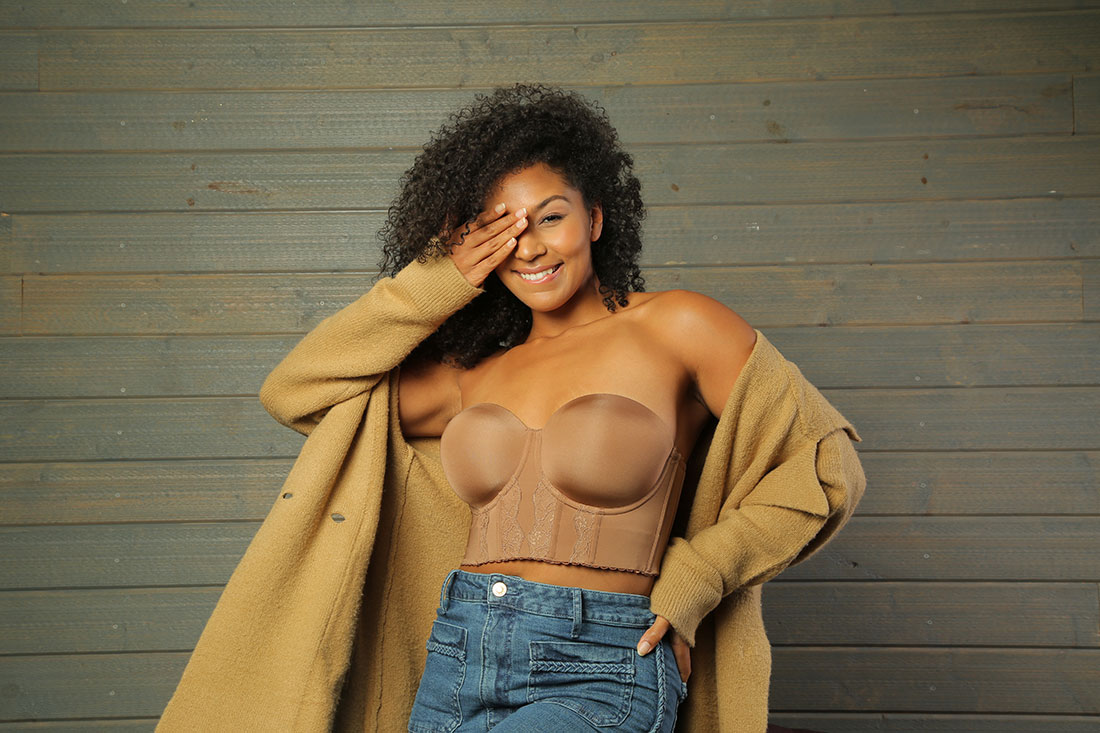
The Elissa Longline Strapless Bra (P50116) is a specialty style where customer reviews add enormous value — strapless bras in extended sizes are notoriously hard to fit, and real customer feedback about how well the Elissa stays in place and supports larger cups is more useful than any campaign photography.

Using Social Media as a Research Tool

Social media isn’t a shopping platform, but it’s an excellent research tool when used systematically. The key is to search with intention rather than browse passively.

Search by product name and style number on Instagram and TikTok. Style numbers (like P5000, P7000) are particularly useful search terms because they return only posts specifically about that product — not general brand content. Posts tagged with a style number are almost always from customers rather than brand marketing.

Look for video content specifically. A short video showing a bra being worn, showing the band from behind, showing the wearer moving — provides more fit information in thirty seconds than a static photo. TikTok has become a particularly rich resource for candid lingerie reviews in extended sizes, partly because the format rewards authenticity over polish.

When you find a reviewer whose body type and size seems similar to yours, it’s worth following or bookmarking them. A reviewer who covers your size range consistently and whose fit assessments have proved accurate in the past is a trusted source you can return to for future decisions.

How to Contribute to the Community You Benefit From

The extended-size shopping community only works because people contribute to it. If you’ve benefited from a stranger’s detailed review or honest photo, the most direct way to pay that forward is to leave the same for someone else.

When you receive a bra, write a review that includes your size (both purchased and usual), specific fit details — not just general impressions — and a photo if you’re comfortable sharing one. The most helpful photos show the back band (level or riding up?), the front (cup sitting flat or gaping?), and ideally a side view showing whether the underwire is sitting correctly.

If you’re not comfortable with photos, a detailed written review that answers the specific questions you had before buying is still genuinely valuable. What did you want to know before you bought this, and what did you discover? That’s the review someone else needs.

Contributing to review ecosystems — on brand sites, on community forums, on social media — makes the extended-size shopping experience better for everyone. It’s also a form of advocacy: a well-reviewed, heavily documented size range is harder for a brand to quietly discontinue than one that barely registers in their customer data. Use Parfait’s Fit Fix tool at parfaitlingerie.com to make sure you’re buying the right size before you post a review, so your fit feedback is accurate and useful to others.

Why 38G Wearers Are Right to Be Skeptical

If you wear a 38G and you’ve tried a wire-free bra before, there’s a good chance it let you down. Not in a subtle, “this could be more comfortable” way — in a very literal, “I’m holding everything up with my hands by noon” way. The skepticism is earned. Wire-free bras have historically been designed with a C or D cup in mind, and the version marketed to larger sizes is often just a scaled-up version of that same inadequate structure. The result is a garment that looks supportive on a flat lay or a size-small model but collapses under real-world use.

Here’s the thing: a 38G wearer is dealing with significantly more volume than a 38C. The tissue mass is roughly double or more, the load on the band is much greater, and the cup geometry is more complex. A wire-free bra at this size isn’t just a comfort preference — it’s an engineering challenge. When it fails, it fails loudly: the cups flatten outward, the band rides up, and by the end of the day your bra has migrated into a position it was never supposed to be in.

So if you’ve given up on wire-free entirely, this post is for you. There are bras in this category that actually work at your size — but you need to know what you’re looking for.

What “Seamless” Actually Means in Bra Construction

The word “seamless” gets used loosely in lingerie marketing. Sometimes it means the cup has no visible seams at all. Sometimes it means the bra’s outer edge is seamless (so it doesn’t show under a T-shirt) but the cup itself has interior structure. And sometimes it’s just a descriptor for a soft, stretchy fabric with no real structural meaning at all.

For the purposes of support, what matters is the interior architecture. A truly seamless molded cup is made from a single piece of material that’s been shaped under heat — there are no seams inside the cup because the cup is a formed unit. This is very different from a wire-free bra with fabric panels that happen to be smooth on the outside. Both can technically be marketed as “seamless.” Only one has the structural integrity to reliably hold a 38G.

Molded seamless cups — especially those made from spacer foam — have a rigid shape that maintains its form independently of the fabric. The cup holds you, rather than you holding the cup in place with friction and hope. This distinction is everything at larger cup sizes. When you’re evaluating a wire-free bra, don’t just look at the outer fabric texture. Feel the cup itself: does it hold its shape when empty? Does pressing on the cup cause it to deform and spring back, or does it collapse and stay flat? The former is what you want.

The Engineering of Wire-Free Support at Larger Cups

Understanding why most wire-free bras fail at larger cups requires a brief foray into bra mechanics. In a wired bra, the underwire performs two jobs: it defines the base of the cup (creating a rigid frame that holds the breast tissue in place), and it distributes the weight of the breast into the band and side panels. Remove the wire and you’ve removed both functions simultaneously. Something else has to replace them.

In a well-engineered wire-free bra, those functions are redistributed. The base of the cup is reinforced with a firmer foam or a structured lining that mimics the shape-defining role of the wire. The side panels are wider and often reinforced with additional fabric or boning-like channels that prevent the cup from migrating laterally. The band is typically wider and made from a higher-stretch recovery fabric, so it doesn’t loosen as the day goes on.

The key physics here: a wire-free bra relies almost entirely on the band for vertical support. If the band is too narrow, too loose, or made from a fabric that loses elasticity over time, the support breaks down. This is why sizing is especially critical in wire-free styles at 38G — you cannot compensate for a loose band with tighter straps the way you sometimes can in a wired bra.

Additionally, the cup needs to contain lateral movement. Without a wire to define the cup’s outer edge, tissue can migrate toward the armpit. Reinforced side panels and a higher underarm cup construction address this. Look for bras where the cup fabric wraps further toward the side of the torso than a standard style.

What to Look for in Foam, Panels, and Band Width

When you’re shopping for a wire-free bra at 38G, here’s a practical checklist of construction features:

Spacer foam cups: Spacer foam is a three-dimensional fabric with a mesh-like structure that creates air channels. It’s firmer than standard foam but lighter, and it’s excellent at holding its shape. Look for this in molded cup styles — it’s often described as “spacer,” “3D foam,” or “breathable foam.”

Wide band: A band that measures at least 4 to 5 centimeters at its widest point (usually at the back) distributes weight more effectively. Narrower bands concentrate load and are more prone to riding up.

Side panel reinforcement: Some wire-free bras include a side support panel — a more structured section of fabric at the armpit edge of the cup. This is the wire-free equivalent of the wire’s outer anchor point.

High-recovery elastic: The elastic in the band and the frame of the cup should feel firm and spring back immediately when stretched. Soft, lax elastic is a warning sign.

Hook-and-eye count: More hooks mean a more stable band connection. Three or four columns of hooks are preferable at this size.

Parfait Wire-Free Styles Worth Trusting at 38G

Parfait has built several wire-free styles specifically for fuller busts — meaning the construction starts from the assumption of significant cup volume, not as an afterthought.

The Holly Wire-Free Padded Bra (P8000) uses a seamless spacer foam cup and a wide, firm band designed for everyday wear. The spacer foam holds its shape through a full day, and the side panels provide enough lateral containment to prevent the migration issues that plague generic wire-free styles. This is probably the most structured option in Parfait’s wire-free lineup and the best starting point for a 38G wearer who needs genuine all-day support.

The Simplicity Wire-Free Bra (P2400) takes a different approach — it’s a lightly padded style with a focus on comfort and clean lines. The cup structure is softer than the Holly, but the band construction is similarly robust. For days when you need wire-free support without the full structure of a padded cup, this is worth trying.

The Adriana Wire-Free Bralette (P5482) is a lace wire-free style that leans more toward soft support than engineered lift. At 38G, it’s best suited for lower-impact days — working from home, a relaxed weekend — rather than as an all-day workwear option. That said, the wider-than-average band and lace construction provide more structure than a standard bralette.

For sizing, Parfait covers bands 28—42 and cups through K (US sizing), so a 38G falls well within their specialty range. If you’re new to the brand, the Fit Fix sizing tool at parfaitlingerie.com can help you confirm your size before ordering.

How to Test a Wire-Free Bra’s Real Support

Before committing to a wire-free bra, run it through a practical test. Put it on and wear it for two to three hours around the house. Then check these things:

Band position: The back band should sit level or very slightly lower than the front. If it’s riding up toward your shoulder blades, the band is too loose or the cups are pulling it up — both signs of inadequate support.

Cup coverage: The cup should contain all breast tissue without cutting in or gaping. Minor gaping at the top of the cup in a wire-free molded style can be normal (wire-free cups often have a more forward projection), but significant gaping or overflow means the cup shape isn’t matching your breast shape.

Shoulder test: Slip both straps off your shoulders. If the bra immediately loses its shape and your breasts drop, the bra is strap-dependent rather than band-supported. A well-fitting wire-free bra should hold its position and provide meaningful support even without straps.

Movement check: Walk briskly, bend over, and stretch your arms overhead. The band should stay put and the cups should contain movement without bouncing or migrating.

Making the Switch: A Realistic Transition Plan

Switching from wired to wire-free after years of wired bras takes some adjustment. Here’s a practical approach:

Start with part-time use. Wear your new wire-free bra for half a day while you transition. Your body is used to the firm containment of underwire, and the different feel of wire-free support takes adjustment — both physically and psychologically.

Don’t size down in the band hoping for more support. A tighter band doesn’t always mean better support in wire-free styles — it can distort the cup shape and cause discomfort without improving lift. Stick to your correct band size and focus on cup accuracy.

Give it a proper trial period. Wear the bra at least three or four times before deciding if it works for you. Initial impressions with wire-free bras can be misleading because they feel so different from wired styles.

Keep your wired bras for high-impact days. Wire-free doesn’t have to be all-or-nothing. Many 38G wearers rotate wire-free styles into their wardrobe for lower-demand days and reserve wired bras for long workdays, active days, or occasions when maximum support is essential. The goal is having options, not making an irreversible switch.

With the right construction features and accurate sizing, wire-free support at 38G is genuinely achievable. The key is knowing what to look for — and not settling for a bra that looks like it should work but doesn’t.

Why 30J Is So Hard to Find

If you’ve ever tried to find a 30J bra in a physical store, you already know the answer: it almost certainly wasn’t there. Most mainstream lingerie brands stop their band range at 32 on the small end and their cup range at DD or DDD on the large end. The combination of a small band with a very large cup sits so far outside the mass-market sweet spot that many retailers don’t stock it at all — not because the size doesn’t exist, but because they don’t expect to find many customers looking for it.

That expectation is part of the problem. People who wear a 30J — or a 28H, or a 30HH — often spend years wearing the wrong size because the right size was never available to them. They either squeeze into a 34F (a common sister-size substitute that doesn’t fit correctly) or go without adequate support entirely. Finding a brand that actually carries these sizes, and carries them well, can be genuinely life-changing.

Understanding why 30J is so rare helps you shop more effectively and advocate for what you need.

The Band-Cup Relationship Most Shoppers Don’t Know

Cup size is not an absolute measurement. It’s a relative one — it describes the difference between your band measurement and your bust measurement, not the volume of your bust on its own. This is the key fact that most people who are new to bra fitting miss, and it explains why 30J exists as a real, meaningful size.

Cup letters represent the difference in inches between the band and the bust. An A cup is roughly a 1-inch difference, B is 2 inches, C is 3 inches, and so on. By the time you reach J, the difference is around 9 inches. That 9-inch difference can happen at any band size — a 32J, a 34J, a 30J, and a 28J all represent the same proportional relationship between band and bust, just at different overall scales.

What this means practically is that a person who wears a 30J has a narrow ribcage (a 30-inch underbust) and a bust that measures approximately 9 inches larger. This is not a rare body type — it’s simply one that requires a small band and a proportionally large cup. The misconception that small bands mean small cups is exactly backwards: small bands combined with large cups represent a small-framed person with significant bust volume, and that combination is entirely real.

What a Small Band With a Large Cup Actually Requires

The engineering challenge in a 30J is significant, and it’s why the size can’t be handled by simply scaling down a larger bra.

In bra construction, the band carries most of the support — roughly 80 to 90 percent of the lift comes from the band, not the straps. A properly fitted band should be firm and close-fitting, sitting parallel to the floor all the way around. In a 30J, this means a band that’s physically narrower than most bras are designed for, carrying the weight of a substantially larger cup than the band size would suggest at first glance.

The cup itself has to be proportionally deep. A 30J cup has approximately the same volume as a 38D — same difference in inches, different scale. But the cup is mounted on a narrower frame, which means the underwire needs to be shorter (shorter wire = narrower fit around the ribcage) while the cup depth remains large. Getting this geometry right is technically demanding and requires specific pattern engineering — it can’t be achieved by simply narrowing the wire on a 38D.

Straps in a small-band large-cup bra also require more attention than in standard sizes. The bust volume is significant relative to the frame, so straps need to be positioned correctly to carry load without digging in. Adjustable straps with robust hardware are important; decorative or very thin straps will not hold up to the demands of the size.

The Sister Size Reality and When It Helps

Sister sizing is a legitimate technique for navigating limited availability, but it has real limits. Your sister sizes are bra sizes that share the same cup volume at different band lengths — go up a band size and down a cup letter, or down a band size and up a cup letter.

For a 30J, the sister sizes would be 28K (one band size smaller, one cup letter larger) and 32HH (one band size larger, one cup letter smaller). Each of these has the same cup volume as a 30J, but the band length is different.

Sister sizing works reasonably well when you’re within one band size of your true measurement and the alternative is no bra at all. But it comes with trade-offs: a 32HH will have a longer band than your ribcage needs, which means the band will ride up, reducing support and possibly causing discomfort. A 28K will have a shorter band, which may feel too tight even for someone whose ribcage actually measures 30 inches.

The best use of sister sizing is as a temporary measure or a way to check if a style works for you in a close-but-not-exact size, with the plan to find your true size when it becomes available. It’s not a permanent solution, especially at the extremes of the size spectrum where the fit difference between adjacent sizes is more pronounced.

What Parfait Offers at the Smaller Band End

Parfait’s size range starts at 28 bands — an unusually small starting point that most mainstream brands don’t reach. This is one of the details that sets Parfait apart in the fuller-bust category: the brand genuinely reaches into petite-band territory with large-cup options, rather than treating 32 as the smallest viable band size.

The Charlene Balconette Bra (P5000) is a structured underwire balconette with contour cups — a style that works well when you need a defined shape and strong support in a smaller band. The balconette cut lifts and rounds, which is particularly useful at smaller band sizes where forward projection is the challenge rather than downward volume.

The Emily Unlined T-Shirt Bra (P7800) offers a smooth, everyday option for smaller bands. Unlined construction at small band/large cup sizes keeps weight manageable while maintaining the seamless silhouette that T-shirt bras are chosen for.

The Shea T-Shirt Bra (P6061) uses spacer foam — a breathable double-knit construction that’s lighter than standard foam while still providing smooth structure. For small-band large-cup wearers who deal with the additional weight of a larger cup, a lighter cup construction can meaningfully reduce fatigue over the course of a day.

The Adriana Wire-Free Lace Bralette (P5482) offers a wire-free alternative for lower-support occasions. Wire-free styles at large cup sizes require careful construction to provide any meaningful support, and a well-made option like the Adriana can work well for lighter-activity days or loungewear needs.

The Holly Wire-Free Padded Bra (P8000) provides seamless wire-free construction — an option for those who prioritize comfort and want to avoid underwire entirely. The seamless design reduces visible lines under fitted tops, which can be a particular concern at smaller band sizes where the torso is more compact.

Fit Signals That Tell You a Small Band Is Working

Knowing whether a small-band bra is doing its job requires checking a few key signals.

The band should sit parallel to the floor all the way around — level at the back, not riding up. If the back of the band is higher than the front, the band is too loose and the cups are pulling it up, which means most of the weight is transferring to your straps instead of the band. This is the most common fit failure in larger cup sizes at any band size.

On the loosest hook, you should be able to fit two fingers under the band comfortably but not much more. The band will stretch slightly with wear over time, which is why you start on the loosest hook — the middle and tightest hooks extend the bra’s life as the band relaxes.

The underwire (if present) should sit flat against your ribcage and chest wall — not digging into breast tissue at the sides or floating away from your sternum at the center. If the wire sits on breast tissue at the side, the cup is too small; if it lifts away from your chest, the wire is too wide for your frame.

Straps should be a supporting actor, not a lead. If your straps are doing most of the work — leaving marks, needing to be very tight — the band isn’t carrying its share of the load.

How to Care for Specialty-Size Bras to Maximize Longevity

Specialty-size bras represent a meaningful investment of time to find and effort to fit correctly. Taking care of them properly extends their useful life significantly.

Hand-washing in cool water with a gentle detergent is the best care method for any underwire bra. The spin cycle of a washing machine puts lateral stress on underwires that can cause them to warp or puncture the casing over time. If you use a machine, a mesh lingerie bag on a delicate cycle with cold water is the minimum protection.

Never put bras in the dryer. Heat degrades both the elastic in the band and the foam or fabric in the cups, accelerating stretching and loss of shape. Air-dry flat or hanging by the band, not by the straps.

Rotate between at least two or three bras rather than wearing the same one every day. Elastic needs time to recover between wearings — typically 24 to 48 hours. A bra worn daily without rest will lose elasticity much faster than one rotated into a regular lineup.

Store bras with cups nested together or laid flat — not folded in half with one cup pushed inside the other, which distorts molded cup shape over time. Parfait’s Fit Fix tool at parfaitlingerie.com can help you confirm your size before ordering, which is especially important in specialty sizes where getting the fit right from the start saves both time and expense.

The Honest Truth About Silk Lingerie in Extended Sizes

Genuine silk lingerie in extended sizes — meaning real mulberry silk constructed with the engineering necessary to support larger cup sizes — is exceptionally rare. This is not a complaint or a call to action. It is simply an honest description of where the market currently stands, and understanding why helps set realistic expectations and find genuinely good alternatives.

Most of what is labeled “silk” in the lingerie market falls into a few categories: pure silk charmeuse or crepe de chine used for slips and chemises that have no structural support requirements; silk-blend fabrics that incorporate nylon or spandex to add recovery; and fabrics with a silk-like hand — satin-finish synthetics — that use the word loosely in marketing copy if at all.

For slips, chemises, and robes, true silk in extended sizes exists and is worth seeking out. For bras — particularly in the E cup and above — the combination of delicate silk and the structural demands of a fuller-cup underwire construction is extremely difficult to execute well. What you will find is much more likely to be a satin-finish fabric, and that is not necessarily a disappointment if you know what to look for.

Why Fabric and Structure Conflict at Larger Cups

A structurally sound bra in a larger cup size needs to do several things simultaneously: hold the underwire in place under tension, support a band that can carry significant load without stretching out, and position the cup in a shape that holds up through a full day of movement. These are engineering requirements that impose constraints on fabric choice.

Silk, even at a relatively heavy weight, has low tensile strength compared to the woven synthetics used in most engineered bras. It does not recover from stretch. It is sensitive to moisture, which is a problem in a garment worn close to the skin. It requires delicate washing that most people cannot realistically provide for an everyday bra. And it is expensive — particularly in the yardage required for a larger-cup, structured style.

The result is a genuine conflict: the fabric that looks and feels most luxurious is also poorly suited to the structural role that a larger-cup bra needs to play. Designers working in this space either compromise on support (using silk in a soft-cup or minimally structured style) or compromise on the luxe aesthetic (using a more engineered base fabric for the structural components, reserving silk or silk-like fabric for decorative trim).

This is why you will find silk-trim bras in fuller-bust sizes — lace or satin ribbon detailing over a nylon-spandex base — but very few fully silk-constructed bras in an F cup or above that also offer serious support.

What “Satin” Really Means on a Lingerie Label

Satin is a weave structure, not a material. A satin weave produces a fabric with a high-luster, smooth front face and a duller back, because the weave pattern keeps most of the warp threads on the surface. That structure can be achieved with any fiber: silk, nylon, polyester, acetate.

Silk satin — made from silk fiber in a satin weave — is the most expensive and most naturally luxurious version. Polyester satin is the most common. Nylon satin sits between them, offering better recovery and durability than polyester while remaining more affordable than silk. Acetate satin has a high luster and tends to drape beautifully but is fragile.

When a lingerie label says “satin,” check the fiber content elsewhere on the label or product description. If no fiber content is listed and the item is inexpensive, assume polyester. If the label says “microfiber satin” or “stretch satin,” you are most likely looking at a nylon or polyester blend with some spandex — fine for a bra, but not silk.

This distinction matters not because synthetics are bad — they are often excellent for lingerie that also needs to be durable and washable — but because accurate expectations lead to better purchases. A nylon satin bra that you know is nylon satin can delight you. A nylon satin bra you thought was silk will disappoint even if it’s objectively a good product.

How to Identify Luxurious-Feeling Fabric in Extended Sizes

Several fabric qualities contribute to what most people experience as “luxurious” in lingerie, and most of them are achievable in non-silk materials:

Weight: Heavier fabrics drape differently from thin ones and tend to feel more substantial against the skin. A 90-gram nylon-spandex fabric has a more luxe hand than a 60-gram version, even from the same weave.

Luster: Satin-finish fabrics reflect light in a way that reads as elevated. Matte microfiber is comfortable and functional but does not carry the same visual quality.

Hand: The initial feel of fabric against your palm — what the industry calls its “hand” — varies between fabric constructions. Smooth, close-knit fabrics with minimal texture feel silkier than open-weave or rough-surface alternatives.

Stretch recovery: Fabrics that return to their original shape after wearing or washing maintain their appearance better over time. Poor recovery leads to that stretched-out, tired look that makes lingerie feel cheap even if it wasn’t.

When reading product descriptions, look for fiber content and fabric weight data, paying more attention to construction details than marketing language. “Luxurious” is a claim. “90-gram nylon satin with 15% spandex” is a fact.

The Problem With “Nude”

For most of the twentieth century, lingerie brands used “nude” as a code word for a single shade: a pale peachy-beige that reflected the skin tone of only a narrow portion of the population. If your complexion fell outside that narrow band — whether you’re deep brown, golden tan, warm olive, or anywhere outside the pale-peach range — a nude bra under a white shirt was anything but invisible. It showed up dark, or simply looked like a color rather than a continuation of your skin. The message, often unintentional but no less harmful, was that one skin tone was the default.

The good news is that the conversation around nude in lingerie has shifted significantly over the past decade. Shoppers are demanding a fuller spectrum. Brands are slowly catching up. And the most inclusive lingerie labels are now building their neutral ranges with intention — which means more people can finally get a bra that genuinely disappears under light-colored tops.

Understanding the problem, though, is the first step to solving it. Here’s what “nude” actually needs to mean, and how to find shades that work for you.

What a True Nude Shade Should Do

A true nude is personal, not universal. It’s the shade that most closely matches the skin on your chest and torso — close enough that a bra worn under a thin white or sheer fabric doesn’t create visible contrast. That definition means there is no single nude. There are hundreds of nudes. The “right” nude for you is the one that blends into your specific complexion.

Functionally, a well-matched nude bra serves three purposes. First, it reduces visual contrast under light fabrics, so the bra doesn’t telegraph through sheer blouses or white shirts. Second, it reads as “nothing there” when a top slips slightly or a neckline gapes — which happens to everyone regardless of cup size. Third, it gives you a go-to layer you can stop thinking about, freeing up mental energy for the outfit itself.

If a bra labeled “nude” doesn’t do those three things for your skin tone, it’s not actually nude for you. It’s just a beige bra. The label is the brand’s shorthand, not your experience.

Go Top